

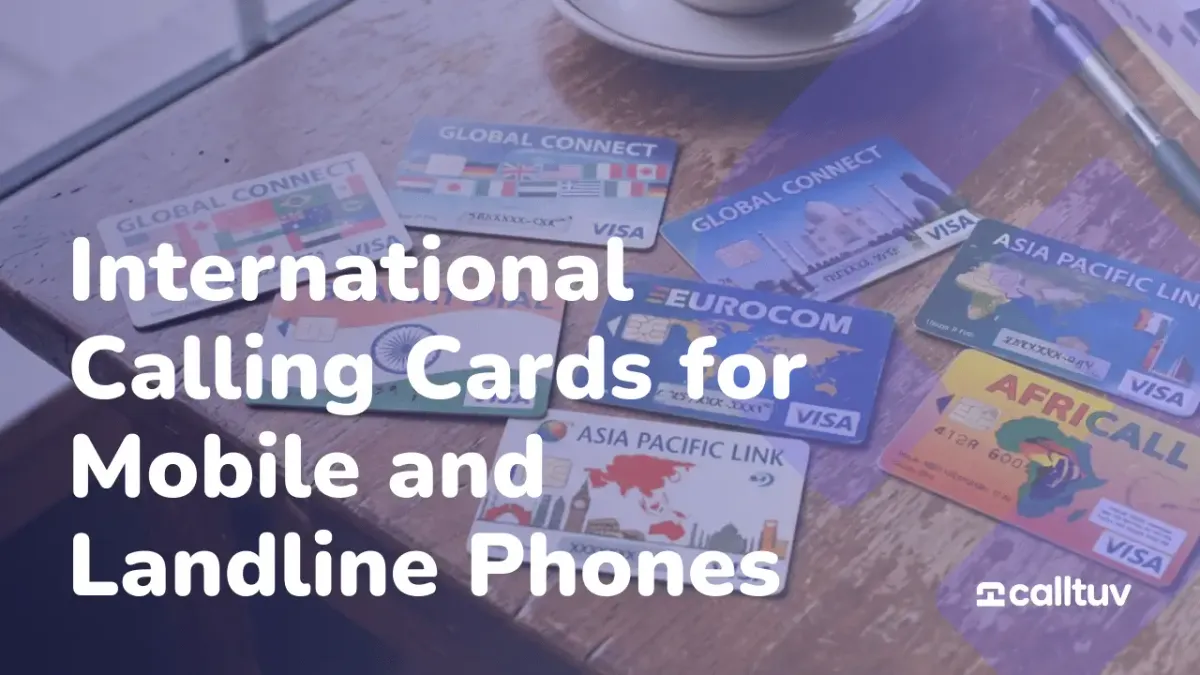
You're trying to reach your mother's landline in another country, and your carrier wants $2.50 per minute for the privilege—with even day-pass users facing $84–$210 in roaming fees over a two-week trip. International calling cards exist precisely for this situation—prepaid credit that lets you dial real phone numbers abroad at a fraction of carrier rates.
This guide covers how calling cards actually work, where to buy them, what hidden fees to watch for, and when browser-based alternatives make more sense than dialing access numbers and entering PINs.
Key Takeaways
- International calling cards offer prepaid credit for calling landlines and mobiles abroad at rates starting under 1¢ per minute, compared to carrier roaming charges of $2-3 per minute.
- Hidden costs like connection fees (50¢-$1 per call), weekly maintenance charges ($1-2), and credit expiration (30-90 days) can significantly reduce the value of advertised per-minute rates.
- Browser-based calling services like CallTuv eliminate the PIN-and-access-number process, allowing direct calls to landlines and mobiles from any web browser without app downloads or expiring credit.
- Calling mobile phones abroad typically costs more than calling landlines in the same country, so checking both rates before purchasing a card prevents unexpected charges.
What are international calling cards
International calling cards are prepaid tools that let you call landlines and mobile phones abroad at rates far below what your carrier charges. You buy credit upfront—either on a physical card from a store or as a digital PIN sent to your email—and that credit depletes as you talk. Rates can start under 1¢ per minute for popular destinations, while carrier roaming often hits $2-3 per minute.
The model is simple: you're buying minutes in advance rather than getting billed afterward. This prepaid approach helps you control spending since you can't exceed what you've already paid for.
Three formats exist today:
- Physical cards: Sold at retail stores with a scratch-off PIN on the back
- Digital cards: Purchased online with instant PIN delivery to your email
- App-based accounts: Credit stored in a mobile app or web portal, no PIN required
How international calling cards work
The basic process involves dialing an access number, entering your PIN, and then dialing your destination. Modern "pinless" options simplify this, but understanding the full sequence helps you avoid confusion the first time.
Access numbers and PIN codes
When you buy a calling card, you receive two things: an access number and a PIN. The access number is typically a local or toll-free number you dial first. Once connected, an automated system prompts you to enter your PIN, which authenticates your prepaid account and tracks your remaining balance.
Some providers now offer "pinless" calling. You register your phone number with the service, and it recognizes you automatically when you call from that line. This eliminates the PIN entry step, though you're then limited to calling from your registered number.
Dialing sequence for landlines and mobiles
The standard sequence works like this:
- Dial the access number (local or toll-free)
- Enter your PIN when prompted (or skip if pinless)
- Dial the full international number: country code + area code + phone number
One detail worth noting: calling mobile phones abroad often costs more than calling landlines in the same country. A card advertising "1¢/min to Mexico" might charge 8¢/min for Mexican mobile numbers. Always check both rates before purchasing.
Prepaid credit and per-minute rates
Your credit depletes based on per-minute rates that vary dramatically by destination. Calling Canada from the US might cost 1¢/min, while calling a mobile in Nigeria could run 15¢/min or higher. The provider's rate table—usually on their website—shows exactly what each country and phone type costs.
Most cards display your remaining balance before connecting each call. If your balance runs low mid-conversation, you'll hear a warning tone before disconnection.
Where to buy international calling cards
You can purchase calling cards at retail stores for immediate use or online for instant digital delivery. The buying experience differs between channels.
Retail stores and convenience locations
Gas stations, grocery stores, pharmacies, and big-box retailers like Walmart and Best Buy stock physical calling cards. You'll find them near the checkout or in the prepaid phone section. Selection varies by location—urban areas with immigrant communities typically offer more options.
The advantage is immediacy: you walk out with a working card. The downside is limited selection and no easy way to compare rates across providers while standing in the store.
Online calling card platforms
Sites like CallingCards.com let you compare dozens of options before purchasing. You'll see rates, fees, and user reviews side by side. After payment, your PIN arrives via email within minutes.
Online buying works well when you have time to research. You can check exact rates for your destination country and read the fine print on fees before committing.
Digital calling cards and apps
Providers like BOSS Revolution operate entirely through apps or web portals. You create an account, add credit with a debit or credit card, and start calling—no physical card or emailed PIN involved. Your balance and call history live in the app.
This approach offers the most convenience for repeat users. However, you're tied to that specific provider's ecosystem rather than shopping around for each purchase.
Best international calling card providers
The right provider depends on where you're calling and how often. Here's how the major options compare:
| Provider | Best For | Rate Range | Key Drawback |
|---|---|---|---|
| BOSS Revolution | Mobile app users | 1¢–15¢/min | Requires app download |
| CallingCards.com | Rate comparison | 0.5¢–12¢/min | Weekly maintenance fees on some plans |
| Talk Home | European destinations | 1¢–10¢/min | Physical card delivery time |
| Rebtel | Frequent callers | 1¢–8¢/min | Subscription model for best rates |
For travelers who want to skip the calling card process entirely, browser-based services like CallTuv let you dial landlines and mobiles directly from any web browser—no PIN, no access number, no app download.
How to choose an international calling card
Comparing cards requires looking beyond the advertised headline rate. Several factors affect your actual cost.
Compare per-minute rates for your destination country
A card advertising "calls from 0.5¢/min" might charge that rate only to Canadian landlines while charging 20¢/min to your actual destination. Before purchasing, find the provider's rate table and look up your specific country. Check both landline and mobile rates since they often differ substantially.
Check for connection fees and maintenance charges
Some cards deduct a flat fee—often 50¢ to $1—every time you connect a call. If you make several short calls, connection fees eat through your balance faster than the per-minute rate suggests.
Maintenance fees are another trap. Certain cards charge weekly fees (typically $1-2) that automatically deduct from your balance whether you call or not. A $10 card with a $2 weekly fee becomes a $6 card after two weeks of sitting in your wallet.
Verify coverage for landlines and mobiles
Not every card covers every destination. Some specialize in specific regions—Latin America, South Asia, Africa—while offering poor rates or no coverage elsewhere. Confirm the card supports calls to both landlines and mobile phones at your destination.
Review credit expiration policies
Prepaid balances typically expire after 30 to 90 days of inactivity. If you're an occasional caller, that $20 card might vanish before you use half of it. Look for cards with longer expiration windows or no expiration at all.
Hidden costs of prepaid phone cards
The advertised rate rarely tells the whole story. Here are the common traps:
Connection fees on every call
A 50¢ connection fee on a 2-minute call effectively adds 25¢/min to your rate. Multiple short calls—checking in with family, confirming reservations—drain credit fast when each one triggers a connection charge.
Weekly or monthly maintenance fees
Ongoing charges reduce your balance automatically, even during weeks you don't call. A card advertising "no expiration" might still charge $1.50 weekly in maintenance, emptying a $10 balance in under two months.
Expiring credit you cannot recover
Most cards offer no refunds or rollovers on unused minutes. Once the expiration date passes, that remaining balance disappears. Some providers reset the expiration clock when you add more credit; others don't.
Low-quality audio on budget cards
The cheapest cards sometimes route calls through congested networks. You might experience delays, echoes, or choppy audio. Testing with a small purchase first helps avoid committing to a card with poor call quality.
Alternatives to international calling cards
If the PIN-and-access-number process feels outdated, several modern alternatives exist. Each trades off differently between convenience, cost, and capability.
Browser-based calling services
Services like CallTuv let you call any landline or mobile worldwide directly from Chrome, Safari, or Firefox. No access number to dial, no PIN to enter, no app to download. You see the exact per-minute rate before each call, and credits don't expire.
This approach works especially well for travelers calling from laptops or tablets.
VoIP and calling apps
Apps like Skype and WhatsApp offer free app-to-app calling, but both parties require the same app installed. That doesn't help when you're calling a hotel, a bank, or your grandmother's landline. Skype does offer paid calling to real phone numbers, though rates and interface complexity vary.
Carrier international calling plans
AT&T, Verizon, and T-Mobile offer add-on international packages—T-Mobile, for example, charges $0.25/min in 215+ countries. Convenient but typically more expensive than calling cards or VoIP alternatives.
How to call landlines overseas without a calling card
You're traveling, your phone works fine on WiFi, and you want to reach a landline back home. Traditional calling cards feel clunky. What are your options?
- Browser-based VoIP: Open your laptop or phone browser, navigate to a service like CallTuv, and dial the number directly. No app installation, no SIM swap, no memorizing access numbers.
- WiFi calling through your carrier: If your plan supports it and you've enabled the feature, your calls route over WiFi but are billed at domestic rates. Check with your carrier before traveling—not all plans include this.
- Calling apps that reach real numbers: Skype's dial-out feature lets you call landlines and mobiles, not just other app users. You'll purchase Skype Credit or a subscription, and rates vary by destination.
Tips for cheaper international calls
1. Compare rates before buying any card
Spend five minutes checking two or three providers for your specific destination. A 2¢/min difference adds up over dozens of calls. Look up both landline and mobile rates since they often differ.
2. Use WiFi calling to avoid roaming
Hotel WiFi, café connections, even airport hotspots—the FCC recommends using VoIP services over any internet connection to avoid your carrier's roaming rates.
3. Avoid cards with short expiration periods
If you call internationally only occasionally, choose cards with 90+ day expiration or no expiration at all. A "cheap" card that expires in 30 days wastes money if you don't use it quickly.
4. Test call quality with a small credit first
Buy $5-10 initially to test audio quality and ease of use. If the experience is poor—delays, echoes, confusing interface—you've lost little. If it works well, add more credit with confidence.
Why browser-based calling beats traditional phone cards
The calling card model made sense in the 1990s. Today, browser-based calling eliminates most of its friction.
- No PINs to remember: Just log in and dial
- No access numbers: Call directly from your browser
- No expiring credit: Your balance stays until you use it
- No app downloads: Works in Chrome, Safari, Firefox
- Transparent pricing: See the exact cost before each call connects
With a service like CallTuv, you can reach any landline or mobile in 200+ countries directly from your browser.
FAQs about international calling cards
Can I use an international calling card from my computer?
Traditional calling cards require a phone to dial the access number—they won't work from a computer alone. Browser-based services like CallTuv let you call landlines and mobiles directly from your computer without any card.
Do international calling cards work for texting or just voice calls?
Calling cards are voice-only. They don't support SMS or text messaging.
What happens to my calling card balance if I lose the physical card?
If you lose the card and didn't register your PIN online, the balance is typically gone. Digital cards avoid this risk since the PIN lives in your email or account.
Can I hide my caller ID when using an international calling card?
Most calling cards display the access number or a generic number to recipients—not your personal number. For true caller ID control where you choose what number appears, browser-based VoIP services offer more flexibility.
Are international calling cards cheaper than WhatsApp for calling landlines?
WhatsApp only calls other WhatsApp users for free—it cannot reach landlines at all. For landline calls, you'll want a calling card, VoIP service, or carrier plan.
Do I need a SIM card to use an international calling card?
You'll want a working phone line—landline, cell phone with SIM, or payphone—to dial the access number. Browser-based alternatives work without any SIM, using only an internet connection.
How long does prepaid international calling card credit last before it expires?
Expiration periods vary by provider, typically ranging from 30 days to one year of inactivity. Always check the terms before purchasing, especially if you call infrequently.