
The Cruise Phone Bill: What AT&T, Verizon and T-Mobile Charge at Sea
AT&T charges $4 a minute on cruise ships without a pass, Verizon $1.99, and both sell a $20-a-day cruise pass. Carnival says none of its Wi-Fi plans support carrier Wi-Fi Calling.

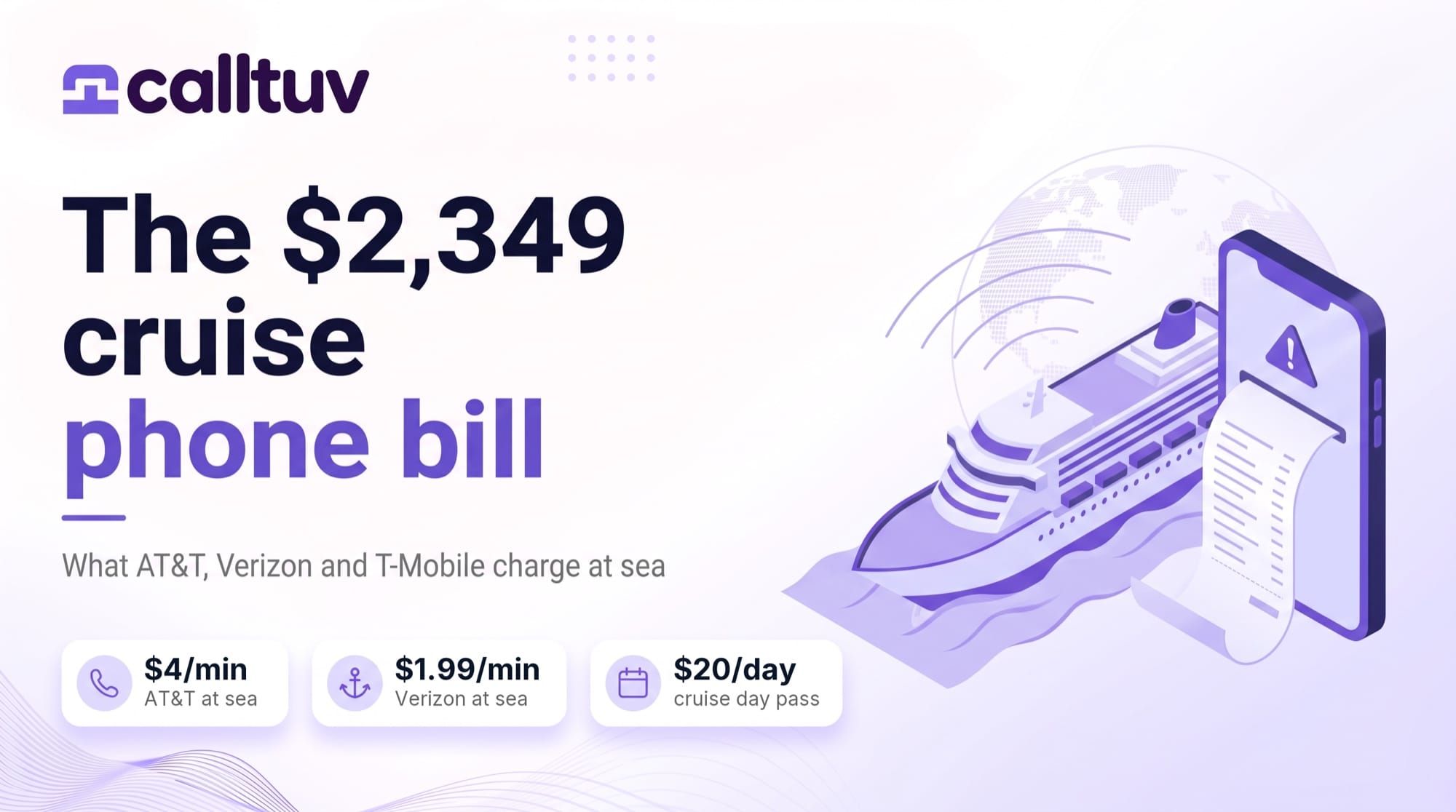
A phone left on during a cruise can pick up the ship's own cell network, your US carrier bills that as roaming at sea, and the charges can arrive after you're home. AT&T's published rate is $4 a minute on cruise ships without a pass. Verizon's is $1.99. Both sell a $20-a-day cruise pass instead. Per phone. And the trick that saves money in a hotel, carrier Wi-Fi Calling, is something Carnival says none of its Wi-Fi plans support.
This page is what AT&T, Verizon, T-Mobile, Carnival and Royal Caribbean publish, read on 7 October 2026, with screenshots, plus the one setting that prevents a surprise bill and the cheapest way to make the calls you'll actually need.
The $2,349 bill
Consumer advocate Michelle Couch-Friedman of Consumer Rescue wrote up the case in June 2024 and updated it in March 2026. A couple took a ten-night anniversary cruise on Carnival's Venezia out of Manhattan. They used their phones on the ship's Wi-Fi, never switched on Airplane mode, and came home to a $2,349 roaming charge from their carrier, Spectrum Mobile. Their phones had been connecting to cell networks at sea the whole time. Spectrum first said the charge was valid. Then Consumer Rescue stepped in. Spectrum removed it.
Two details in that story matter for everyone. Being on Wi-Fi didn't stop the phones using cellular. And the couple got no warning until the cruise was over, by which point ten days of a phone quietly talking to whatever network it could find had already been billed, at rates the couple had never looked up.
What AT&T, Verizon and T-Mobile charge at sea
| At sea, on the ship's cell network | AT&T | Verizon | T-Mobile |
|---|---|---|---|
| Calls without a pass | $4 a minute | $1.99 a minute | Varies by cruise line |
| Cruise pass | Day Pass, $20 a day on 400+ cruise ships | Cruise Daily Pass, $20 a day | Rates shown by its cruise lookup |
| What the pass covers for calls | Day Pass includes Wi-Fi Calling on select cruise ships at sea | Unlimited minutes to the US | Not stated as a flat pass |
Read on 7 October 2026. Every figure is from the carrier's own page.
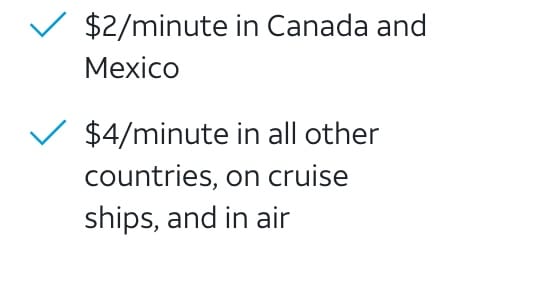
AT&T. Its pay-per-use rates are $4 a minute in all countries outside Canada and Mexico, on cruise ships, and in the air. Its international page prices the Day Pass at $20 a day on 400+ cruise ships, and its page on international Wi-Fi calls says the Day Pass fee includes Wi-Fi Calling on select cruise ships while at sea.
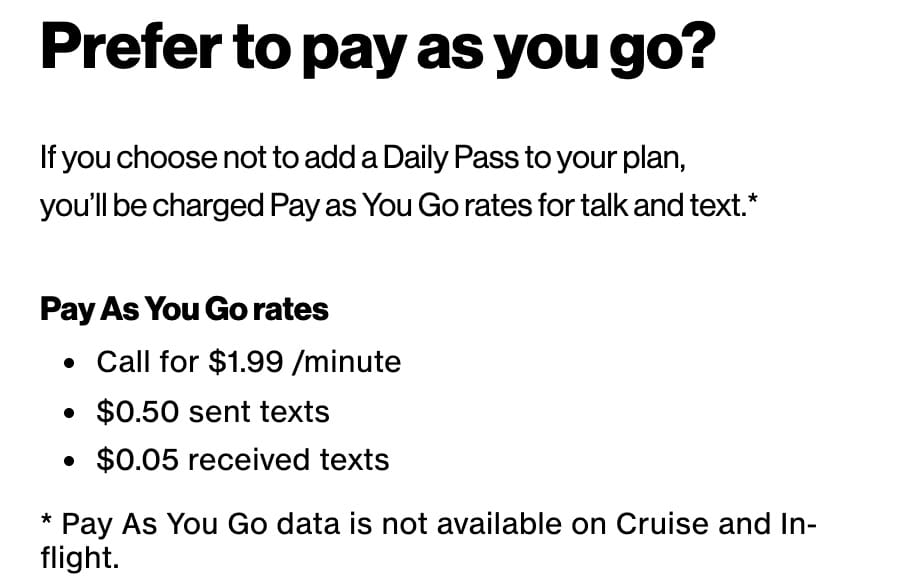
Verizon. Its cruise page sells the Cruise Daily Pass at $20 per line per day, with unlimited minutes to the US, unlimited texts and 0.5 GB of high-speed data. Without it, calls are $1.99 a minute. Sent texts, $0.50 each. Its Cruise Daily Pass FAQ adds that a session starts when you make or answer a call, send a text or use data aboard, background data such as app refreshes included, and that calls to countries outside the US cost the same as if you were calling from home.
T-Mobile. Its international plans page recommends turning roaming off while the ship is docked in a US port, because otherwise your phone may pick up the ship's network and you'll pay cruise ship roaming charges. It shows the rates for each ship through a cruise lookup, and its Wi-Fi Calling page says calls on cruise ship and ferry networks are charged at World Class Calling rates. We couldn't get the lookup to return a rate. So we don't print one.
Why Wi-Fi Calling doesn't save you on a Carnival ship
In a hotel abroad, carrier Wi-Fi Calling makes calls home to US numbers free, as we explain in the truth about Wi-Fi Calling abroad. On a Carnival ship that option is gone. Three plans. Same answer on all three.
| Carnival Wi-Fi plan | Price before sailing | Carrier Wi-Fi Calling | What it does allow |
|---|---|---|---|
| Social | From $20.40 per person per day | Excluded | Social apps including WhatsApp, airline sites; no FaceTime |
| Value | From $23.80 | Not supported | Social sites plus email and browsing; no video streaming |
| Premium | From $25.50 | Not supported | Everything, plus streaming, video chat, FaceTime and Zoom where coverage allows |
From Carnival's internet plans pages, read 7 October 2026. Carnival prices these per person per day and says booking before sailing saves up to 15% against onboard prices.

Note the wording. Carnival's term for it is "cellular-network-dependent Wi-Fi calling", which is the Wi-Fi Calling your carrier runs. App calls are a different thing, which is why the same pages that rule out Wi-Fi Calling can still name video and messaging apps: the Premium plan lists FaceTime and Zoom where coverage allows, and even the cheapest Social plan includes WhatsApp, though it leaves out FaceTime. Royal Caribbean's FAQ says its VOOM internet lets guests video chat using FaceTime or Skype, and it doesn't address carrier Wi-Fi Calling.
The one setting that prevents the bill
Airplane mode. Put the phone in Airplane mode before the ship leaves port, then switch Wi-Fi back on if you've bought a package. That's the fix Consumer Rescue gives in the $2,349 case. Consumer Rescue's point is that Airplane mode is the only way to be certain the phone won't connect to a cell tower, while Wi-Fi still works. Then check. The airplane icon should still be there after you join the ship's Wi-Fi. T-Mobile's advice for docked ships, turning roaming off, comes from the same worry: a phone that's switched on keeps looking for a network.
Which calls to make, and where
Most calls on a cruise can wait for the next port, and that's where they cost least. Ship Wi-Fi is shared by every passenger on board, and our own customers have told us it can be too slow or unsteady for a phone call: one wrote this week that calls struggled on the ship's basic Wi-Fi and worked as soon as the ship reached port. A public review on our Trustpilot page says the same, ending with every call working flawlessly once she was on land.
- Family who use WhatsApp or FaceTime. Use the app, on the ship's Wi-Fi if your plan allows it or in port.
- Everyone else, in port. The tour operator who hasn't shown up at the pier, the restaurant you want a table at before the ship sails again, the hotel for the night after you dock, your bank's fraud line when the card gets declined at a souvenir stall, an airline about the flight home. CallTuv calls any number from the browser or the iPhone and Android apps, over port Wi-Fi or a local SIM, and the dialer shows the rate before you call.
- Emergencies. On board, tell the crew. Ashore, dial the local emergency number from the phone's own dialer. CallTuv can't call emergency numbers.
Rates from the live rate card, checked 7 October 2026:
| The call, from port | Landline | Mobile | 10 minutes |
|---|---|---|---|
| A restaurant in Cozumel, Mexico | $0.04 | $0.10 | $0.40 to $1.00 |
| A tour operator in Barcelona, Spain | $0.04 | $0.10 | $0.40 to $1.00 |
| A hotel in Rome, Italy | $0.04 | $0.09 | $0.40 to $0.90 |
| A taxi on Santorini, Greece | $0.05 | $0.15 | $0.50 to $1.50 |
| Your US bank or airline, toll-free included | $0.03 | $0.30 | |
No pass needed. Calls are billed per minute, rounded up. Credit starts at $5, never expires, and there's no subscription. US toll-free numbers dial at the ordinary US rate; more in how to call 1-800 numbers online.
Method and sources
Carrier and cruise line pages were read on 7 October 2026: AT&T's pay-per-use rates, international page and Learn about international Wi-Fi calls; Verizon's Cruise and in-flight page and Cruise Daily Pass FAQ; T-Mobile's international plans, cruise and Wi-Fi Calling pages; Carnival's Social, Value and Premium Wi-Fi plan pages; Royal Caribbean's VOOM FAQ. The $2,349 case is Consumer Rescue's account, published 9 June 2024 and updated 13 March 2026; we haven't seen the bill. T-Mobile's at-sea per-minute rate isn't printed because its cruise lookup didn't return one. What customers told us about calling over ship Wi-Fi is their experience, not a test of every ship. CallTuv rates come from calltuv.com/pricing.md. Reuse is welcome with a link to this page.
FAQ
How much does it cost to make a call on a cruise ship?
Without a pass, AT&T charges $4 a minute on cruise ships and Verizon $1.99 a minute. Both sell a $20-a-day cruise pass. T-Mobile's rate depends on the cruise line.
Can you use Wi-Fi Calling on a cruise ship?
Not on Carnival: its Social, Value and Premium Wi-Fi plans all say cellular-network-dependent Wi-Fi calling isn't supported. AT&T says its Day Pass includes Wi-Fi Calling on select cruise ships at sea.
Should I put my phone in Airplane mode on a cruise?
Yes, before the ship leaves port. Airplane mode stops the phone connecting to the ship's cell network, and you can still switch Wi-Fi on. Consumer Rescue's $2,349 case happened because a couple on ship Wi-Fi never turned it on.
Will I be charged if I'm only using the ship's Wi-Fi?
Not for the Wi-Fi itself (T-Mobile, for one, says it doesn't charge for data used over Wi-Fi), but a phone that isn't in Airplane mode can still connect to the ship's cell network in the background. That's how the couple in the Consumer Rescue case ran up their bill.
What does Verizon's Cruise Daily Pass include?
Verizon says $20 per line for a 24-hour session with unlimited minutes to the US, unlimited texts and 0.5 GB of high-speed data, charged only on days you use the phone at sea. Background data counts as use, so turn cellular data off if you don't want a session started.
What does AT&T charge for a cruise?
AT&T's Day Pass costs $20 a day on 400+ cruise ships. Without it, AT&T's pay-per-use rate is $4 a minute on cruise ships.
Can I use WhatsApp or FaceTime on a Carnival cruise?
Carnival's Social plan includes WhatsApp but excludes FaceTime. Its Premium plan names FaceTime and Zoom. Ship Wi-Fi is shared, so call quality depends on the connection.
What's the cheapest way to call a local number from a cruise port?
An internet calling service on port Wi-Fi or a local SIM. With CallTuv it's $0.04 a minute to a landline in Mexico, Spain or Italy, and $0.03 to US numbers, toll-free included.