
How to Call Mexico from the US (and the 1 You Should Not Dial)

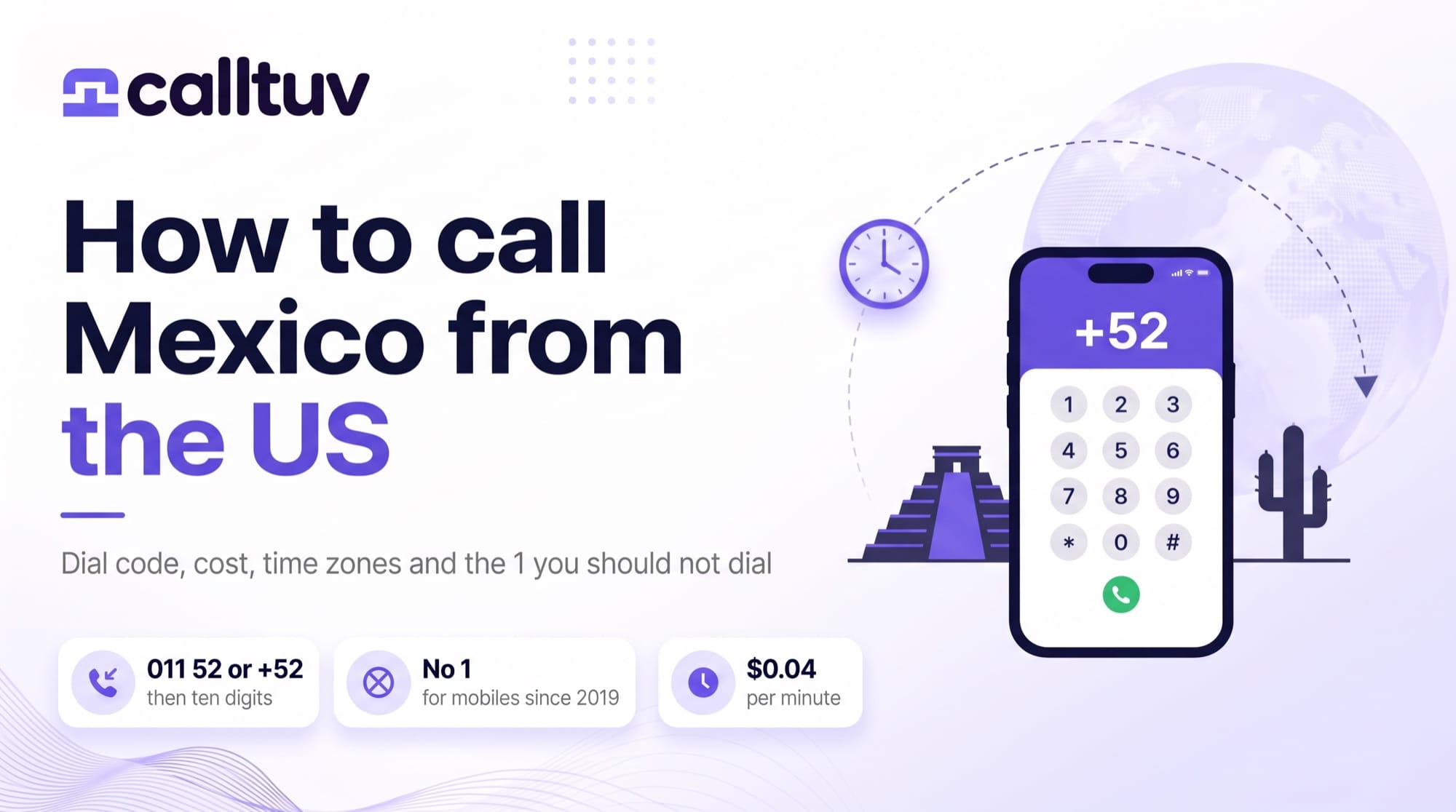
From a US landline, dial 011 52 and then the ten-digit Mexican number. From a mobile, or from a calling app, hold 0 until a + appears and dial +52 and the same ten digits. That's it. Landline in Mexico City, mobile in Guadalajara, an 800 number: the same three pieces. No extra digit for a cell phone. Not since 2019.
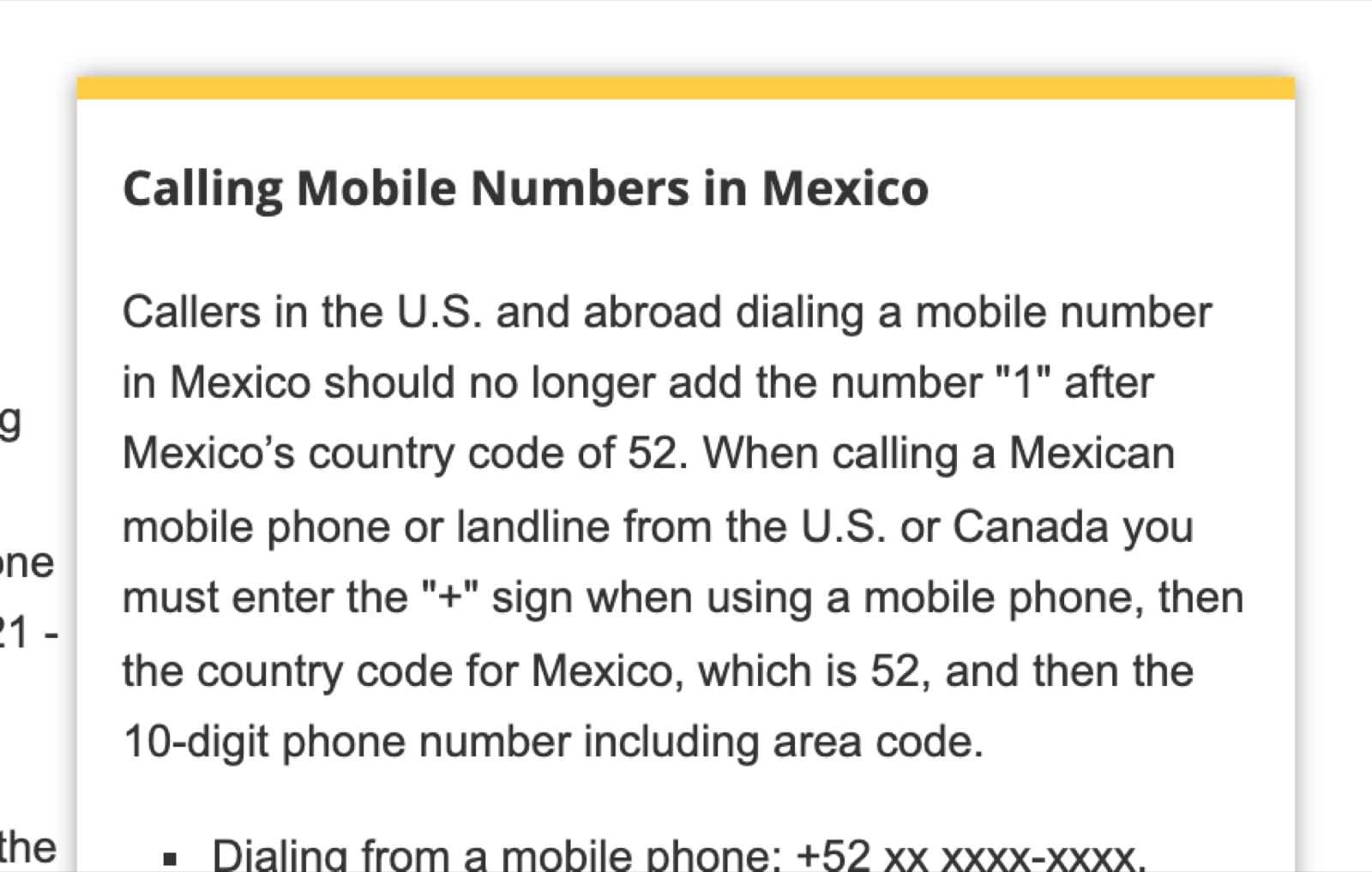
That last part is the reason this guide exists, because two of the four pages Google ranks highest for this question still tell you to add a 1 after the 52 when you're calling a Mexican mobile. Mexico's telecoms regulator retired that 1, along with the 044 and 045 prefixes, when it moved the whole country to ten-digit numbers on 3 August 2019, and the FCC's own tip sheet now says, in a section written just for this, that callers "should no longer add the number 1". Dial it anyway and you're dialling an eleven-digit number that doesn't exist.
So: the format with examples, the retired 1 and where it still lurks, the area codes for the cities people actually call, what it costs (four cents a minute from a browser or an app), the time zones now that Mexico has stopped changing its clocks, and ten Mexican numbers our customers have reached from abroad, nine of which answered in Spanish.
The short version
| You have | From a US landline | From a mobile, or a calling app |
|---|---|---|
| A Mexico City landline, 55 5133 4000 | 011 52 55 5133 4000 | +52 55 5133 4000 |
| A Guadalajara mobile, 33 1234 5678 | 011 52 33 1234 5678 | +52 33 1234 5678 |
| A Mexican 800 number, 800 226 2663 | 011 52 800 226 2663 | +52 800 226 2663 |
Three pieces every time: the US exit code (011, or + on a mobile), Mexico's country code (52), and the ten-digit national number. Always ten. A Mexican number is an area code of two or three digits plus a local number of eight or seven, and the two always add up to ten, which is what makes the 2019 change so tidy: a number you'd dial inside Mexico is exactly the number you put after +52 from outside it.
If a number was written down before 2019 it may carry a prefix that no longer exists: 01 for long distance, 044 or 045 for mobiles, or a lone 1 after the country code. Strip all of them. Every one. The regulator's own checklist tells Mexicans to go through their phone contacts and delete those digits, and the same applies to the number on your cousin's old business card.
The 1 that was retired, and the guides that still print it
Until 2019, calling a Mexican mobile from abroad meant dialling +52, then 1, then the number, a leftover of the "caller pays" mobile system. The Instituto Federal de Telecomunicaciones ended that with a single nationwide change: from 3 August 2019 every fixed and mobile number in Mexico became a plain ten-digit number, dialled the same way from anywhere, and after a one-year transition the old prefixes stopped connecting on 3 August 2020. The IFT's ten-digit dialling page spells out the format from abroad: the international access code, then 52, then the ten-digit national number, "no importando si es fijo o móvil", whether it's fixed or mobile.
The FCC updated its consumer tip sheet to match. It's short enough to quote in full:
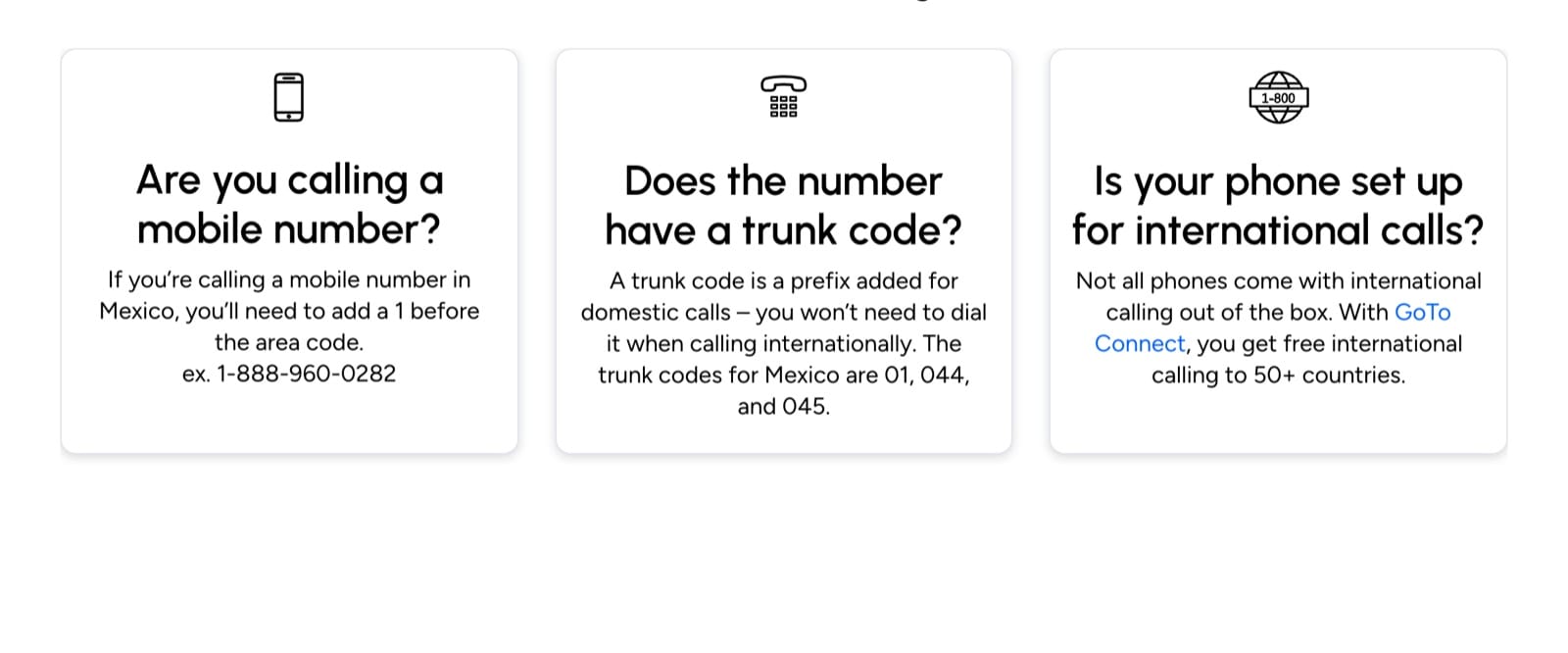
And yet. On 22 September 2026 the second result on Google for "how to call Mexico from the US" was a GoTo Connect guide whose first checkpoint reads "If you're calling a mobile number in Mexico, you'll need to add a 1 before the area code", with the retired 01, 044 and 045 trunk codes listed alongside as if they were current.
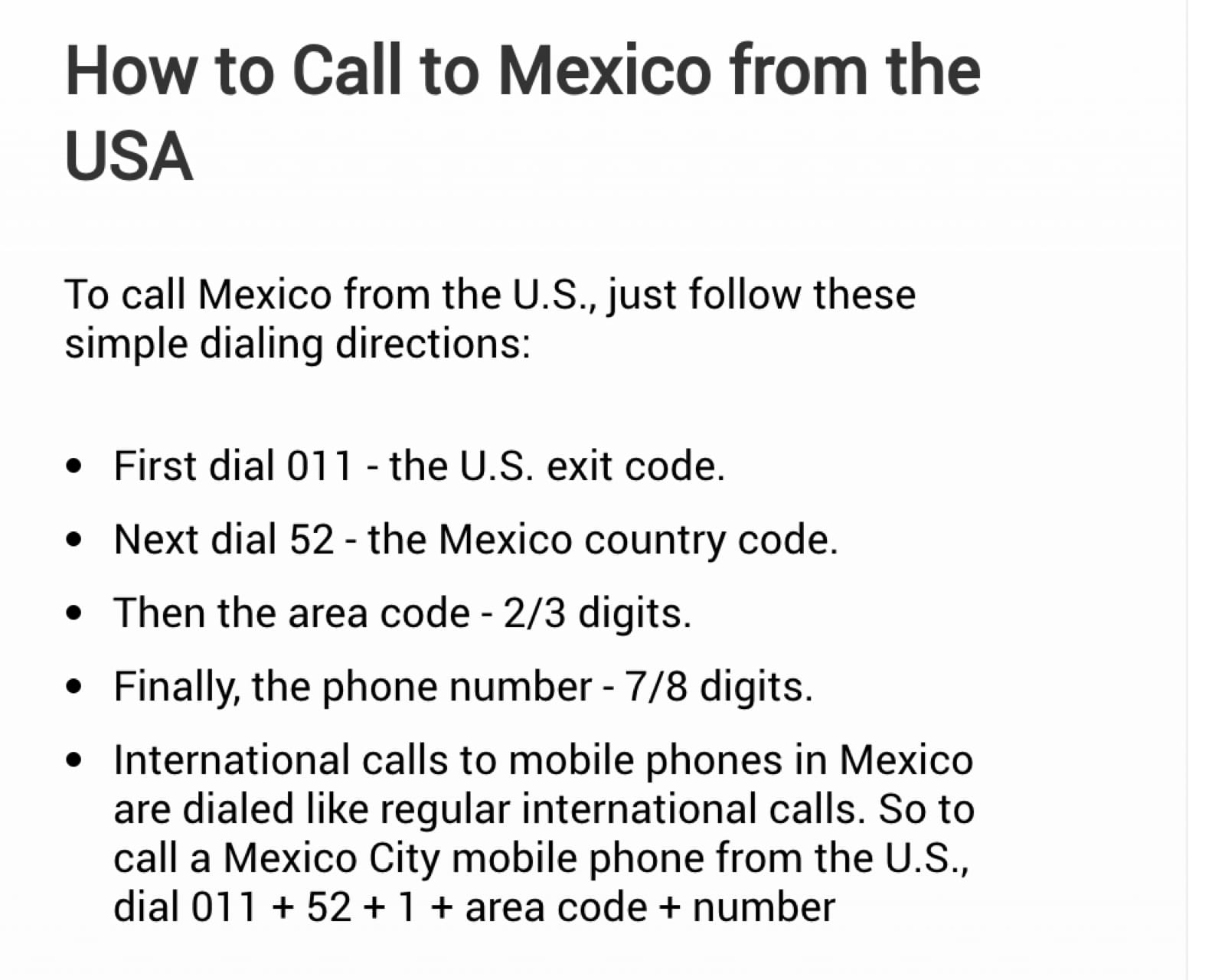
The fourth result, a Vonage page, ends its dialling steps with "to call a Mexico City mobile phone from the U.S., dial 011 + 52 + 1 + area code + number".
Neither page is malicious. They were right once. Nobody went back. It does mean that if you searched, followed the top results, added the 1 as instructed and got a fast busy tone or a recorded message in Spanish you couldn't quite follow, the number wasn't the problem and neither was your phone, because you were dialling a digit that was deleted seven years ago. Our own dialler won't even accept it: type +52 1 55 and ten digits and it asks for a complete number, because there's no valid Mexican number of that length.
Area codes for the cities people call
Mexico City, Guadalajara and Monterrey have two-digit codes and eight-digit local numbers. Everywhere else has a three-digit code and seven local digits. Ten, either way.
| City | Area code | Dial from a US mobile or app |
|---|---|---|
| Mexico City | 55, 56 | +52 55 xxxx xxxx |
| Guadalajara | 33 | +52 33 xxxx xxxx |
| Monterrey | 81 | +52 81 xxxx xxxx |
| Tijuana | 664 | +52 664 xxx xxxx |
| Cancún | 998 | +52 998 xxx xxxx |
| Puebla | 222 | +52 222 xxx xxxx |
| Querétaro | 442 | +52 442 xxx xxxx |
| Mérida | 999 | +52 999 xxx xxxx |
| León | 477 | +52 477 xxx xxxx |
| Los Cabos | 624 | +52 624 xxx xxxx |
| Ciudad Juárez | 656 | +52 656 xxx xxxx |
| Oaxaca | 951 | +52 951 xxx xxxx |
| Toluca | 722 | +52 722 xxx xxxx |
| Acapulco | 744 | +52 744 xxx xxxx |
| Veracruz | 229 | +52 229 xxx xxxx |
| Mexicali | 686 | +52 686 xxx xxxx |
One consequence of the 2019 change that trips people up: a mobile and a landline in the same city now share the same area code and the same shape, so nothing in the digits tells you which one you're calling. A 55 number could be a bank's switchboard. It could be a phone in someone's pocket. That matters for cost, which is next.
What it costs
US carriers sell Mexico two ways: as a per-minute international rate, or bundled into a monthly plan that renews until you cancel it. Both are built for a weekly call to family. Neither is built for the forty-minute hold with a bank's fraud line or the airline call at 6am, and a plan you pay for twelve months in order to use it in one is a poor deal however cheap the minutes look on the brochure. One hold. Gone.
Pay-per-minute from a browser or an app is the other model. On CallTuv, as of 22 September 2026, the Mexico rate page reads:
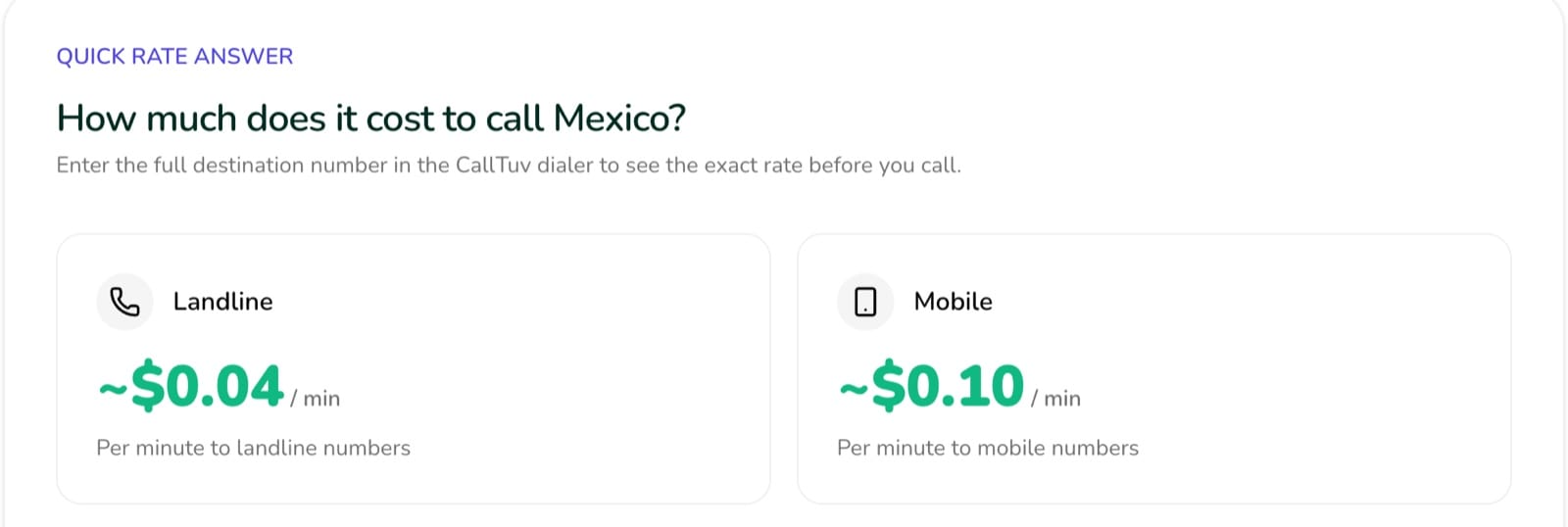
| Calling from the US to | Per minute | A 10-minute call | A 45-minute hold |
|---|---|---|---|
| A Mexican landline | $0.04 | $0.40 | $1.80 |
| A Mexican mobile | up to $0.10 | up to $1.00 | up to $4.50 |
| A Mexican 800 number | $0.04 | $0.40 | $1.80 |
The mobile figure is a ceiling, and here the 2019 change works in your favour. Because a Mexican mobile and landline now share one ten-digit format, the dialler prices the exact number you type rather than a category, and every Mexican number we put through the public price lookup on 22 September, including the ten directory lines below, the two 800 lines among them, and test numbers in the 55, 33, 81, 664 and 998 codes, came back at $0.04. The figure the dialler shows before you press call is the one you're billed, so read that, not the table.
Prices are in US dollars, billed per whole minute. You need three minutes of credit at the destination rate to start a call, so twelve cents is enough to begin dialling Mexico. Credit starts at $5, which is 125 minutes at the landline rate, and it doesn't expire, so a $5 top-up before a trip is still there the next time the bank blocks your card. No plan. Nothing renewing. Nothing to cancel.
When to call: the time zones
Mexico stopped changing its clocks in October 2022. The US didn't. The Ley de los Husos Horarios put the country on standard time year-round, with an exception for municipalities along the northern border that keep US-style daylight saving so that Tijuana and Ciudad Juárez stay in step with the cities across the line (the Energy Ministry's note on the change is the plain-language source). So the gap between you and Mexico City changes twice a year, on 1 November 2026 and 14 March 2027, even though Mexico City itself does nothing. Offsets below are from the IANA time zone database, version 2026c.
| You're calling | Mid March to early November (US on daylight time) | Early November to mid March (US on standard time) |
|---|---|---|
| Mexico City, Guadalajara, Monterrey, Mérida, Puebla, León, Oaxaca | Same time as Denver; 1 h behind Chicago; 2 h behind New York; 1 h ahead of Los Angeles | Same time as Chicago; 1 h behind New York; 1 h ahead of Denver; 2 h ahead of Los Angeles |
| Cancún, Playa del Carmen (Quintana Roo) | Same time as Chicago; 1 h behind New York | Same time as New York |
| Hermosillo, Mazatlán (Sonora, Sinaloa) | Same time as Los Angeles | Same time as Denver |
| Tijuana, Mexicali (border, keeps daylight saving) | Same time as Los Angeles | Same time as Los Angeles |
| Ciudad Juárez (border, keeps daylight saving) | Same time as Denver | Same time as Denver |
In practice? From New York, most of Mexico is two hours behind you in summer and one in winter. From Los Angeles it's the other way, an hour ahead in summer and two in winter. Nine of the ten directory numbers below are on Mexico City time, so a New Yorker calling at 9am in July is ringing a switchboard where it's 7am, and a Californian calling at 5pm in January reaches an office where it's already 7pm.
Calling a Mexican number from a browser or app, step by step
The same steps work on the web dialler in Chrome, Safari, Firefox or Edge, and in the iPhone and Android apps, on one balance.
- Type the number as +52 and the ten digits. No 011, no 1, no 044. If you paste a number written as 01 55 1234 5678 or +52 1 55 1234 5678, delete the 01 or the 1 first.
- Read the per-minute rate the dialler shows under the number before you press call. For a valid Mexican number it will say $0.04 or, at most, $0.10.
- Expect Spanish. Nine of the ten lines in the directory below greeted callers in Spanish and the tenth has no greeting recorded. If a menu offers "para inglés", the keypad is on screen for the whole call, and key presses are sent as signals the menu registers rather than as tones played into the microphone, which is what makes "oprima 1" work over an internet call in the first place. Details in our note on phone menus.
- If the call won't connect, check the number against the area code table first. Most failed calls to Mexico are format errors, and our troubleshooting guide covers the rest.
Mexican numbers our customers have reached from abroad
These are numbers in Mexico that CallTuv customers have connected to, with the organisation that answered confirmed. Ten lines, nine of them banks or card issuers, which tells you what people abroad need to call in Mexico: the bank that blocked the card, the card issuer that flagged the hotel deposit, the airline that changed the flight. Each was reachable when it was reached, and rates were checked on the public price lookup on 22 September 2026.
| Organisation | Number | Answered in | Rate |
|---|---|---|---|
| Aeroméxico | +52 55 5133 4000 | Spanish | $0.04 |
| American Express (Monterrey) | +52 81 8319 9111 | Spanish | $0.04 |
| American Express (800 line) | +52 800 504 0400 | Spanish | $0.04 |
| Banamex | +52 55 1226 2639 | Spanish | $0.04 |
| BanBajío | +52 477 710 4699 | Spanish | $0.04 |
| BBVA (Línea BBVA) | +52 55 5226 2663 | Spanish | $0.04 |
| BBVA (800 line) | +52 800 226 2663 | Spanish | $0.04 |
| INVEX Banco | +52 55 4000 4000 | Spanish | $0.04 |
| Santander | +52 55 5169 4300 | Spanish | $0.04 |
| Scotiabank | +52 55 5728 1900 | not recorded | $0.04 |
Two of those are 800 numbers. They deserve a word. A Mexican 800 number is toll-free only for callers inside Mexico. From a US carrier it's an international call, if your carrier completes it at all, so check before you rely on one. From the browser or the app both lines above connected and were quoted at the ordinary $0.04. If a company gives you both an 800 and a geographic number, the geographic one is the safer bet from abroad, and it costs the same.
What a call to Mexico from an app can't do
Three limits. Better here than at the wrong moment.
It can't reach emergency services. 911 works inside Mexico from a Mexican or a roaming phone; an internet calling service can't route to it, and CallTuv doesn't support emergency numbers anywhere. If someone in Mexico needs help, they call 911 locally.
It can't receive. CallTuv is outbound only, with no number of its own, so it can't take a call back or a text. When a Mexican bank sends a confirmation code, it goes to the mobile number on your account, so keep that phone reachable, on Wi-Fi if nothing else.
And it isn't the answer for everyone. Mexico runs on WhatsApp. If the person you're calling is on it, use it; a WhatsApp call over Wi-Fi costs nothing. The cases for a per-minute call are the ones WhatsApp can't cover: the bank, the airline, the hotel front desk, the 800 line, the relative with a landline and no smartphone.
Where this comes from
The dialling format is from the IFT's ten-digit numbering pages and the FCC's International Calling Tip Sheet, both read on 22 September 2026, and the two guides quoted were read the same day at the positions Google gave them for "how to call Mexico from the US" in a US search. Area codes are as assigned under the IFT's numbering plan and cross-checked against the directory numbers we hold. Time offsets are computed from IANA tzdata 2026c, which encodes the 2022 law and the border exceptions. Rates are from the live rate card and the public price lookup on the same date, and can change; the dialler shows the current figure before every call. The directory records which numbers people needed from abroad, not which numbers exist, and a number that was reachable in September 2026 can be retired later, so if one fails, check the company's own site before assuming the route is the problem.
Reuse is welcome with attribution and a link.
Frequently asked questions
What is the code to call Mexico from the US?
From a landline, dial 011 (the US exit code), then 52 (Mexico's country code), then the ten-digit Mexican number. From a mobile or a calling app, replace 011 with +, so a Mexico City number reads +52 55 1234 5678.
Do I dial 1 before a Mexican cell phone number?
No. Mexico removed the 1 for mobiles, along with the 044 and 045 prefixes, when it moved to ten-digit numbering on 3 August 2019, and the FCC's tip sheet says callers "should no longer add the number 1" after 52. A mobile and a landline are dialled identically: +52 and ten digits.
How do I call a Mexican cell phone from the US?
Exactly like a landline: 011 52 or +52, then the ten-digit number. If the number you were given starts with 044, 045, 01 or a lone 1 after the country code, drop those digits; they're from before 2019.
How much does it cost to call Mexico from the US?
On a carrier plan, whatever your international rate or add-on is. On CallTuv it's $0.04 a minute to a Mexican landline or 800 number and up to $0.10 to a mobile, billed per whole minute, and every Mexican number we quoted on 22 September 2026 came back at $0.04. Credit starts at $5 and doesn't expire.
Can I call a Mexican 800 number from the US?
Sometimes from a US carrier, since an 800 number is free only inside Mexico and is treated as an international call from outside. From the CallTuv browser dialler or app the two 800 lines in our directory, American Express and BBVA, connected at $0.04 a minute.
Is a +52 55 number a mobile or a landline?
You can't tell from the digits. Since 2019 mobiles and landlines share the same ten-digit format and the same area codes, so 55 could be either. The dialler prices the exact number before you call, which is the reliable way to know what it will cost.
What time is it in Mexico City when it's 9am in New York?
7am from mid March to early November, and 8am the rest of the year. Mexico City doesn't change its clocks; the US does, so the gap moves. From Los Angeles, Mexico City is one hour ahead in summer and two in winter. Cancún is an hour ahead of Mexico City all year.
How do I call the US from Mexico?
The other direction uses Mexico's exit code, which is 00: dial 00 1 and the ten-digit US number from a Mexican landline, or +1 and the number from a mobile. US toll-free numbers often won't connect from a Mexican SIM; our guide to calling 1-800 numbers online covers the way round that.