
The Toll-Free Wall: 76% of US Customer Service Lines Are 1-800 Numbers, and 89% of the People Calling Them Are Abroad

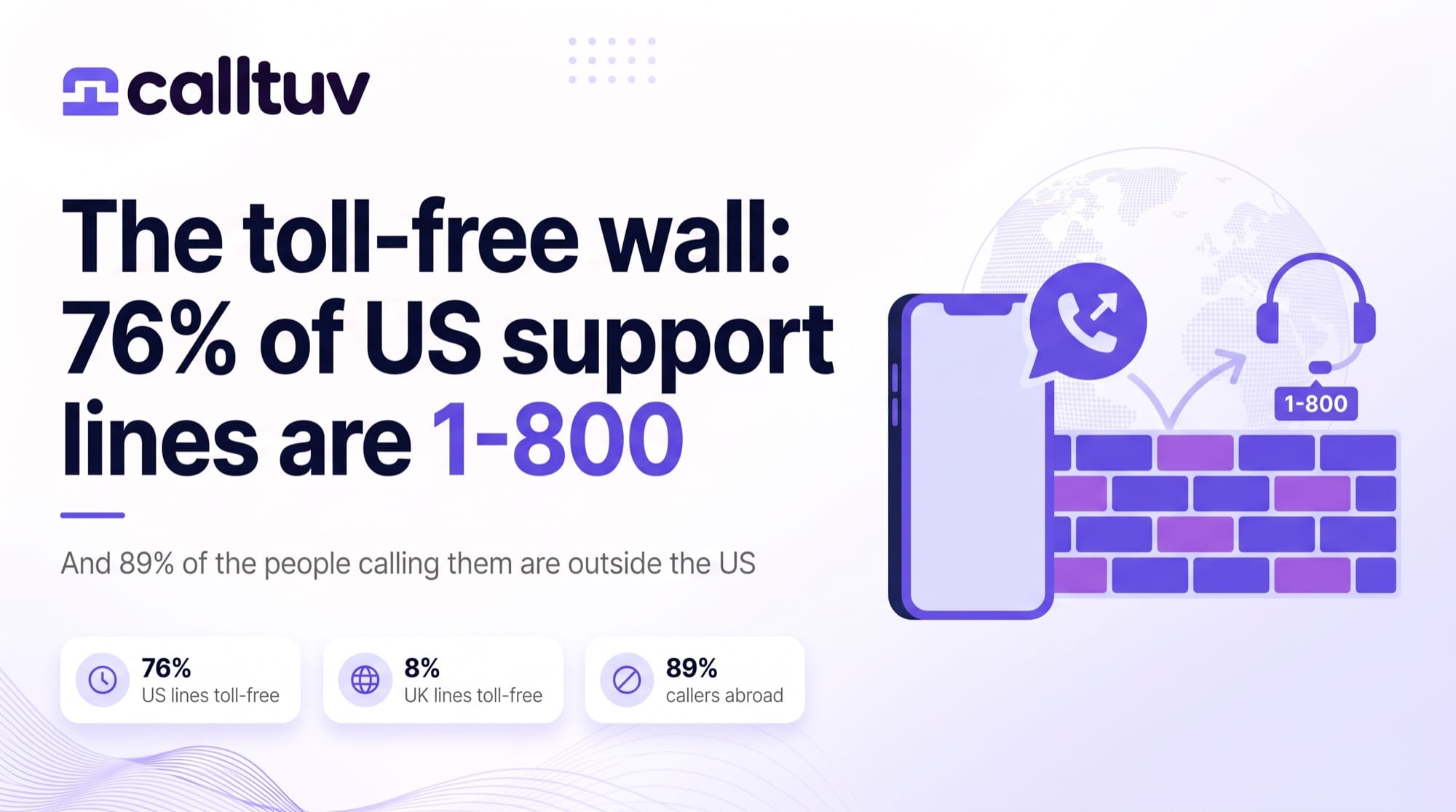
Three out of four US customer service lines our customers needed are toll-free, and toll-free numbers weren't built to be dialled from abroad. Of 320 US organisation lines in our directory, 243 (76%) start with 800, 888, 877 or another toll-free code. For 110 of the 170 organisations behind them, a toll-free number was the only line anyone in the directory reached. In the UK the same count is 8%. In Germany, France, Italy and the Netherlands it's zero.
And the people dialling those numbers aren't in the US. Of the CallTuv customers who called a US toll-free number between 25 June and 22 September 2026, 89% signed up from outside the United States, in 150 different countries. Toll-free lines took 30% of every call our customers placed to a US number.
Put those two facts side by side. The US runs its customer service on a kind of number that stops at the border, and the people who most need to get through, the student whose card was frozen in Lisbon, the retiree in Chiang Mai chasing a Social Security payment, the traveller whose flight home was cancelled overnight, are almost all on the far side of it. Call it the toll-free wall.
The short answer: can you call a US 1-800 number from abroad?
Sometimes. Don't count on it. AT&T, writing for its own customers, puts it more bluntly than we would:

"In many cases, calls to toll-free numbers (800, 888, etc.) won't complete when you travel outside the U.S. If they do, they're billed as international calls, not calls to the U.S." That's from AT&T's page on Wi-Fi calls abroad. Even Wi-Fi calling doesn't get you round it.
What does work: calling the number from a service that places the call inside the US, such as CallTuv in a browser or its iPhone and Android apps. There, +1 800 432 1000 is just another US number, at $0.03 a minute (checked on our public price lookup on 23 September 2026). Same digits. Different road.
The rest of this piece is the data behind the problem, and the fallbacks the banks themselves publish.
Why toll-free numbers stop at the border
The FCC's guide to toll-free numbers lists seven codes: 800, 888, 877, 866, 855, 844 and 833. The company pays for the call instead of you, and, in the FCC's words, "calls to each toll free number are routed to a particular local telephone number."
That routing lives inside the US network. Once you're outside it, whether the call goes through at all is up to the carrier you're on, in Bogotá or Bangkok or anywhere else. Some connect it and bill it as an international call. Plenty don't. You find out by trying.
The US is the outlier
Other countries have freephone numbers too. They just don't lean on them. Here's the same count across every country with at least 12 organisation lines in our directory, as of 23 September 2026:
| Country | Lines reached | Toll-free | Share |
|---|---|---|---|
| United States | 320 | 243 | 76% |
| Canadian organisations | 61 | 37 | 61% |
| Spain | 32 | 5 | 16% |
| United Kingdom | 197 | 16 | 8% |
| UAE | 15 | 1 | 7% |
| Australia | 68 | 4 | 6% |
| Germany | 42 | 0 | 0% |
| France | 14 | 0 | 0% |
| Singapore | 13 | 0 | 0% |
| Italy | 12 | 0 | 0% |
| Netherlands | 12 | 0 | 0% |
| Israel | 12 | 0 | 0% |
Canada shares the US toll-free system, which is why it's the only country anywhere near. Then the UK. It's the instructive one. Of its 197 lines, 106 are ordinary 01 or 02 landlines and 68 are 03 numbers, which GOV.UK prices exactly like a geographic call. So when a British bank, airline or tax office gives out its main number, it's usually one that works from Madrid or Manila exactly as it does from Manchester, because there's nothing special about it at all. Boring. Useful.
Airlines show the split most sharply. 27 of 29 US airline lines are toll-free. Of 18 UK airline lines, one is. Think about who calls an airline. Often it's someone in another country, at a gate or in a hotel lobby, whose flight home just vanished from the departures board, and in the US that's the industry most completely hidden behind numbers that don't reach abroad. Two lines out of 29.
Which US industries hide behind toll-free
| Category | Lines reached | Toll-free | Share |
|---|---|---|---|
| Airlines | 29 | 27 | 93% |
| Retail | 11 | 10 | 91% |
| Mobile carriers and internet | 25 | 22 | 88% |
| Tech | 7 | 6 | 86% |
| Banks and card issuers | 113 | 87 | 77% |
| Insurance | 11 | 8 | 73% |
| Brokerages | 21 | 15 | 71% |
| Government | 29 | 20 | 69% |
| Travel | 22 | 15 | 68% |
| Payments and money transfer | 23 | 14 | 61% |
| Everything else | 29 | 19 | 66% |
| All US lines | 320 | 243 | 76% |
Government comes in lower mainly because a few agencies run ordinary lines. The IRS is one, and it's the best example of how simple the fix is. More on that below.
Who's actually dialling them
This is the part nobody else can see. Our own calls. Over the 90 days from 25 June to 22 September 2026, 89% of the customers who called a US toll-free number through CallTuv had signed up outside the US, and the calls averaged 10 minutes each. After the US itself, the countries they signed up from most were, in order: the United Kingdom, Colombia, Brazil, Thailand, the Philippines, India, Chile, Japan, Canada and Argentina, with 140 more countries after them.
Ten minutes on average. Hold music included. Nobody spends that long checking opening hours. These are the ten toll-free lines called by the most customers, most first:
| Rank | Line | Number |
|---|---|---|
| 1 | Bank of America | +1 800 432 1000 |
| 2 | Chase | +1 800 935 9935 |
| 3 | Bank of America, mobile banking | +1 800 933 6262 |
| 4 | Social Security Administration | +1 800 772 1213 |
| 5 | Wells Fargo | +1 800 869 3557 |
| 6 | Capital One | +1 877 383 4802 |
| 7 | T-Mobile | +1 800 937 8997 |
| 8 | American Airlines | +1 800 433 7300 |
| 9 | Capital One | +1 800 227 4825 |
| 10 | Chase, credit cards | +1 800 432 3117 |
What the banks tell you to do instead: a collect call
Big US banks know about the wall. They publish a way round it, and it's worth reading what that way round actually is, because in 2026 the official answer from several of the largest card issuers in the world is to ask a telephone operator in whatever country you're standing in to place a reverse-charge call on your behalf.
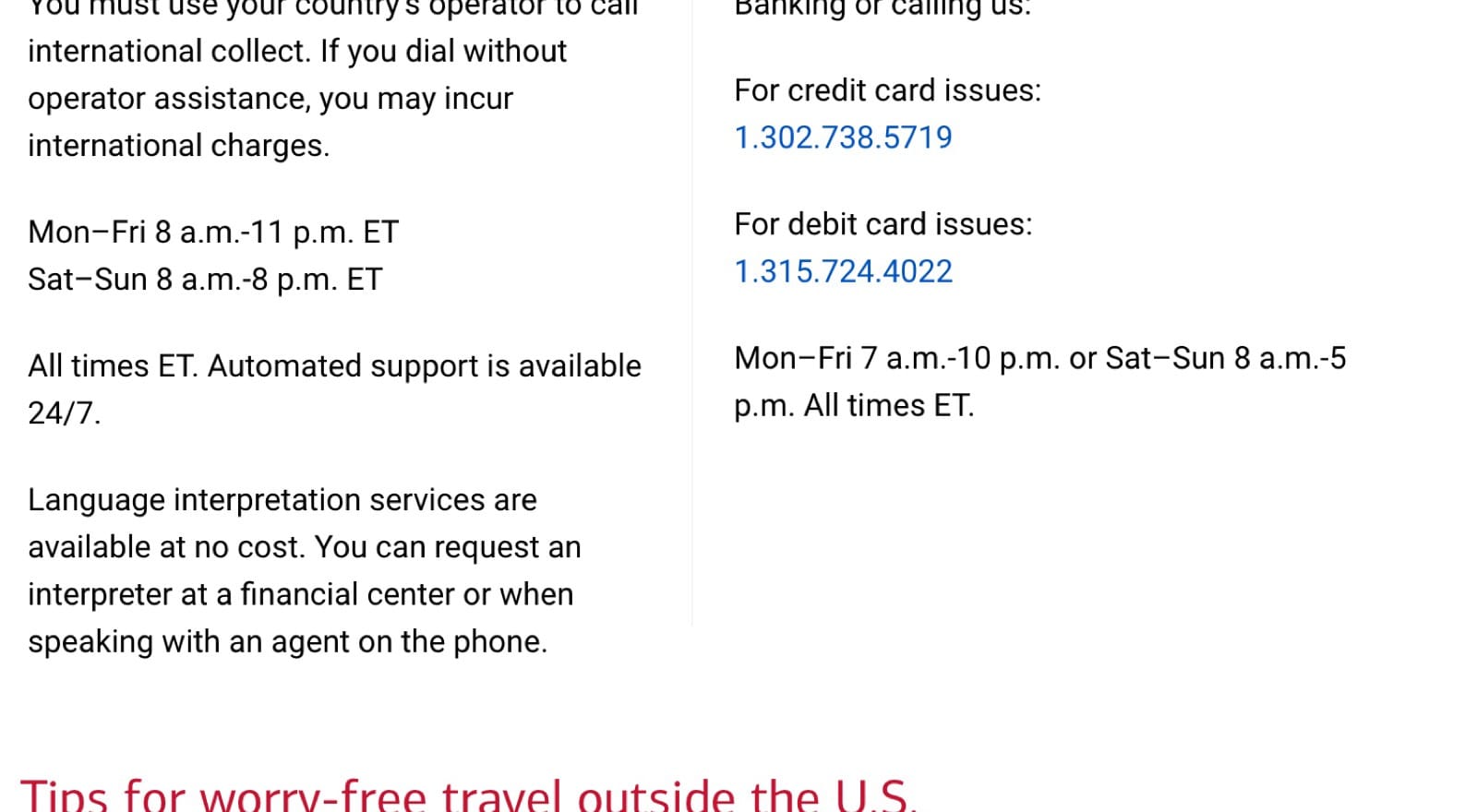
Bank of America's answer is an international collect call to +1 315 724 4022, and "you must use your country's operator to call international collect. If you dial without operator assistance, you may incur international charges." American Express says the same thing: ask the operator to use your country's access code plus 336-393-1111. Capital One's contact page reads "Credit card outside the US, call collect", and gives 1-804-934-2001.
Wells Fargo tried harder. It built a table of international access codes, one per country, 79 countries long. 49 of them come with a "calling limitations" note, mostly about payphones, and a few that say mobile phones block toll-free calls outright. Mexico gets its own warning right at the top of the page:
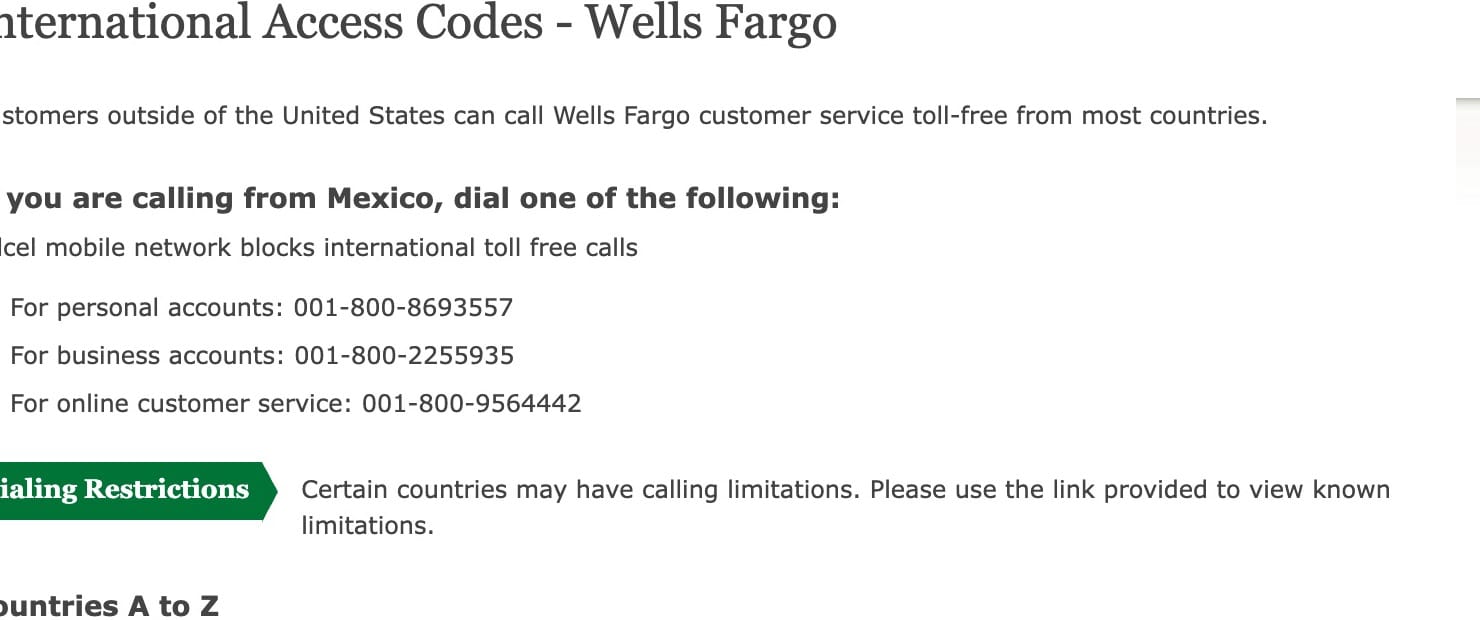
For any country missing from the list, Wells Fargo says to call +1 775 335 1115, and "calls will be billed to you at the applicable rates for the country and service you are calling from."
Then there's the IRS. It simply runs an ordinary line. Its international page lists 267-941-1000, marked "not toll-free", Monday to Friday, 6 a.m. to 11 p.m. Eastern.
The regular numbers that do work from abroad
Every one of these is an ordinary US number. It connects from anywhere. Dialled from a foreign SIM without an operator, it's an international call at whatever your carrier charges for calling the US from the country you're in, which is a number worth checking before a long hold queue rather than after it. From CallTuv, each one was $0.03 a minute on 23 September 2026.
| Organisation | Number | What their own site says |
|---|---|---|
| Bank of America | +1 315 724 4022 | International collect; also the debit card line for lost or stolen cards |
| Bank of America, credit cards | +1 302 738 5719 | Lost or stolen credit card, from outside the US |
| American Express | +1 336 393 1111 | Collect, through the local operator |
| Capital One | +1 804 934 2001 | Credit card outside the US, collect |
| Wells Fargo | +1 775 335 1115 | For countries not on its access-code list, billed to the caller |
| IRS | +1 267 941 1000 | International taxpayers, not toll-free |
A collect call costs you nothing if you can get an operator to place one. That's a real if. When you can't, dial the same number directly. There's a longer list of verified numbers in our piece on what to do when your phone is stolen abroad, and a timing guide for getting through to the IRS.
How to call a US toll-free number from abroad
- Open CallTuv in any browser, or in the iPhone or Android app. Your phone's SIM isn't involved, so it doesn't matter which country's network you're on.
- Dial the number with +1: +1 800 432 1000, not 00 1 or 011 1.
- Check the rate on screen before you connect. A US toll-free number is billed like any US number, $0.03 a minute. There's no subscription, and credit doesn't expire.
- Use the keypad for the menu. Key presses land in phone menus once the call connects, so "press 2 for card services" works (help article).
Two limits. CallTuv only makes outgoing calls, so it can't receive a callback or a text code. And it can't reach emergency numbers, so use a local phone for those. For the step-by-step version of all this, see our guide to calling 1800 numbers online.
Method and caveats
Two datasets, both read on 23 September 2026.
The directory. CallTuv keeps a directory of organisation numbers our customers have connected to, with the organisation that answered confirmed. It held 976 numbers. 357 carry a US code; 37 of those belong to 22 Canadian organisations (Air Canada, RBC, the Canada Revenue Agency and others) and we set them aside, leaving 320 lines at 170 US organisations. A US number counts as toll-free when it starts with one of the seven FCC codes. That's the whole rule. For other countries we used each country's freephone range (0800 and 0808 in the UK, 1800 in Australia, 900 in Spain, 0800 in Germany, and so on). Australia's 13 and 1300 numbers are shared-cost, not free, so they're not counted.
One big caveat. The directory shows which numbers people needed from abroad, not every number that exists. Customers abroad are exactly the people who struggle with toll-free lines, so if a US company offers both a toll-free number and an ordinary one, the directory is more likely to have caught the toll-free one, because that's the one somebody couldn't get through to on their own phone and came to us to dial. That's why the country comparison matters. The UK and German figures come from the same directory, built the same way, and they still don't come close.
The calls. Completed calls with a non-zero duration, 25 June to 22 September 2026, to numbers starting +1 800, 833, 844, 855, 866, 877 or 888. "Signed up from" is the country recorded when the account was created. It isn't where the caller was at the time, so an American who signed up at home and called from Lisbon counts as US. If anything, that understates how many calls came from abroad. Accounts we've blocked are excluded.
Reuse is welcome with attribution and a link to this page.
Frequently asked questions
Can I call a US 1-800 number from abroad?
From a foreign SIM, sometimes. Many calls won't connect, and AT&T says that "in many cases" toll-free calls won't complete outside the US and are billed as international calls when they do. From a browser or app service that places the call inside the US, such as CallTuv, they connect like any US number, at $0.03 a minute.
Why don't toll-free numbers work internationally?
The company pays for a toll-free call, and the FCC says each number is routed to a particular local US line. That arrangement lives inside the US network. Abroad, it's up to your carrier whether the call connects at all, and if it does, AT&T says it's billed as an international call.
Is it free to call a US toll-free number from another country?
No. Toll-free only means free when you call from inside the US, because the company has agreed to pay for calls that reach it through the US network, and a call from a foreign carrier either doesn't connect or arrives as an ordinary international call that you pay your carrier for at its usual rate. Through CallTuv it costs $0.03 a minute, the same as any US number.
Do toll-free numbers work with Wi-Fi calling abroad?
Not reliably. The AT&T warning quoted above is on its page about Wi-Fi calls from outside the US.
What number do I call for my US bank from abroad?
Most big banks publish a regular +1 number for customers abroad, usually as a collect line: Bank of America +1 315 724 4022, American Express +1 336 393 1111, Capital One +1 804 934 2001, Wells Fargo +1 775 335 1115.
How much of US customer service is on toll-free numbers?
In our directory of numbers customers actually reached, 243 of 320 US lines (76%) are toll-free, including 27 of 29 airline lines. For 110 of 170 US organisations, a toll-free number was the only line in the directory.
How do I make a collect call to the US?
Ask the local operator in the country you're in to place an international collect call to the US number the bank gives you. The bank accepts the charge. If no operator is available, you can dial the same number directly and pay for the call yourself.