
Half of US Customer Service Lines Thank You for Calling. In German, It's 1 in 30
Half of US and UK customer service lines open by thanking you for calling. In German it's 1 in 30. What 681 greetings in 55 countries say first.

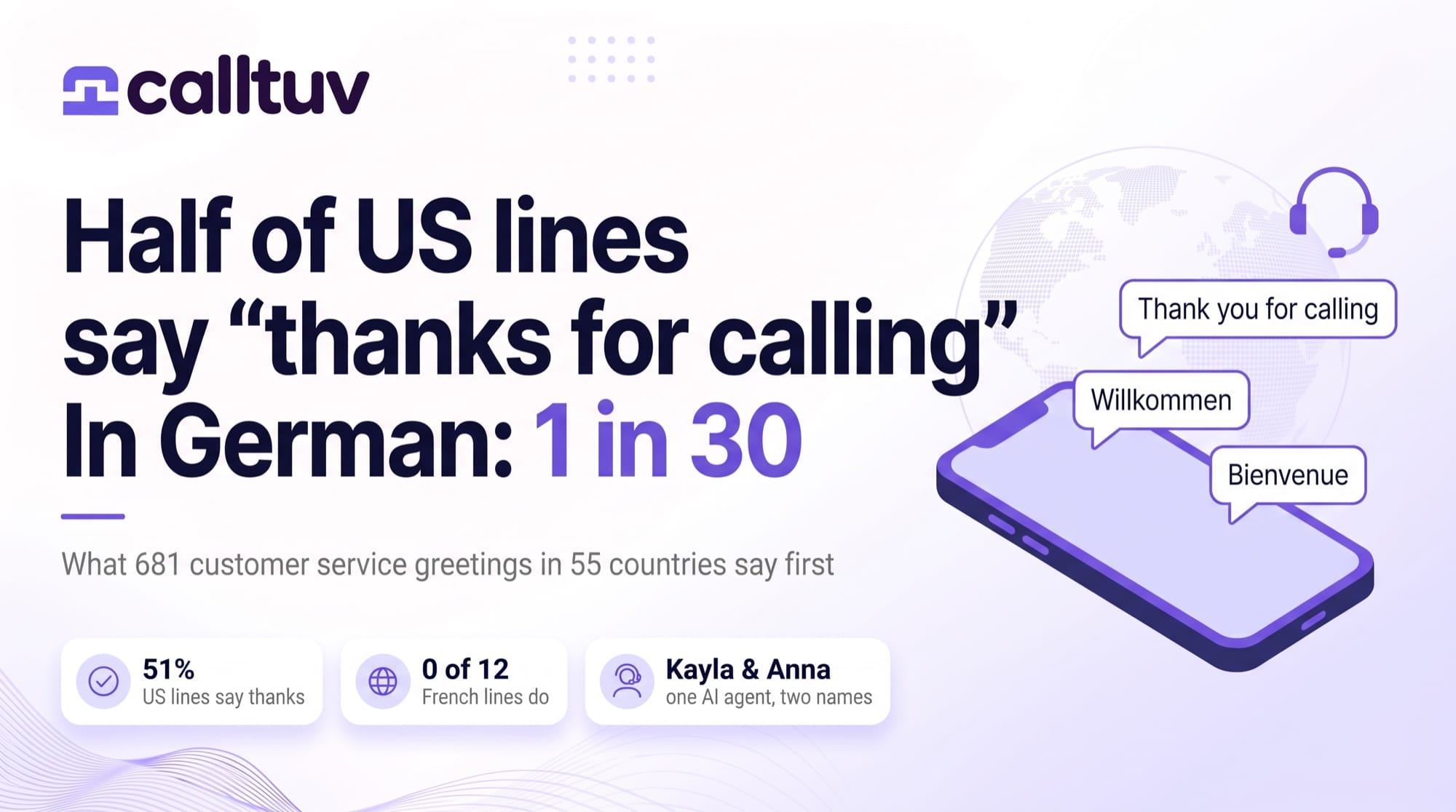
Half of all American customer service lines open by thanking you for calling. In German it's 1 in 30. We went through the greetings on 797 phone lines at 471 organisations in 55 countries, every one of them a line our customers have actually reached, and wrote down the first words each one said. Americans and Brits thank you. Almost everybody else welcomes you instead, and once you've heard the pattern in a few dozen recordings from a few dozen countries, you start to hear it everywhere, in every queue, on every hold. Try it.
The split is sharp. 51% of US lines and 50% of UK lines start with "Thank you for calling" or "Thanks for calling". Cross to Australia and New Zealand and that drops to 28%. Canada? 25%. English-language lines in Singapore, Hong Kong, Malaysia, the Philippines and India, 12%. And in German, French and Italian the thank-you almost vanishes: 1 of 30 German greetings, 0 of 12 French ones and 0 of 7 Italian ones open with thanks. They say "Herzlich willkommen", "Bonjour et bienvenue", "Benvenuto".
Nobody wrote a rule about this. As far as we can tell nobody decided it on purpose, either: it's what call-centre managers, voice actors and compliance teams in each country separately settled on when somebody asked them what the recording should say first, and their habits turned out to line up almost perfectly with the border. Odd, really. But very consistent.
The short answer: who says what
Here's how English-language greetings open, by where the line is:
| Where the line is | Greetings | Open with "Thank you for calling" | Open with "Welcome" |
|---|---|---|---|
| United States | 227 | 51% | 36% |
| United Kingdom | 122 | 50% | 40% |
| Australia and New Zealand | 50 | 28% | 66% |
| Canada | 16 | 25% | 62% |
| UAE, Saudi Arabia, Qatar | 12 | 25% | 75% |
| Singapore, Hong Kong, Malaysia, Philippines, India | 26 | 12% | 77% |
The rest open some other way: "Hello", "Good afternoon", or just the company's name. Consumer Cellular says "Consumer Cellular." and that's it.
And in other languages:
| Language | Greetings | Open with thanks | Open with welcome | What you usually hear |
|---|---|---|---|---|
| Spanish | 58 | 26% | 69% | "Bienvenido a..." / "Te damos la bienvenida a..." |
| German | 30 | 3% | 90% | "Herzlich willkommen bei..." |
| Portuguese | 18 | 6% | 50% | "Bem-vindo ao..." |
| French | 12 | 0% | 83% | "Bonjour et bienvenue chez..." |
| Dutch | 9 | 11% | 67% | "Welkom bij..." |
| Italian | 7 | 0% | 100% | "Benvenuto in..." |
Some of these samples are small. We'd not bet the house on Italy's perfect score. But when 27 of 30 German lines say willkommen and only one says danke, the pattern isn't noise.
Who thanks you most
Inside the US, it depends a lot on what you're calling. Travel companies thank you almost every time: 79% of US travel greetings, from booking sites to cruise lines and car hire, open with thanks. "Thank you for calling Priceline." "Thanks for calling Expedia. We're here to help." Payment companies, 71%. Airlines, half. Booking sites, cruise lines and car-hire desks say thanks as if you'd done them a personal favour by ringing. Maybe you have.
Banks are different. American banks lean the other way, 49% welcome to 36% thanks, which puts them closer to Sydney than to the travel agent down the road. "Welcome to Chase Sapphire." "Welcome to Citibank."
In the UK the most grateful callers-back are, of all things, government lines. 11 of 16 UK government greetings open by thanking you, 69%, more than any other UK line type we measured. The Department for Work and Pensions manages a full 19 words before you can press anything: "Thank you for calling the State Pension and Pension Credit line, part of the Department for Work and Pensions."
| Line type | Greetings | Thanks | Welcome |
|---|---|---|---|
| US travel | 14 | 79% | 21% |
| US payments | 17 | 71% | 24% |
| US airlines | 22 | 50% | 32% |
| US government | 21 | 48% | 43% |
| US telecom | 21 | 38% | 48% |
| US banks | 81 | 36% | 49% |
| UK government | 16 | 69% | 19% |
| UK banks | 35 | 46% | 49% |
| UK telecom | 10 | 30% | 70% |
"Good morning" is an Asian bank thing
Only 11 English-language greetings in the whole directory say good morning, good afternoon or good evening. Five of them are in Singapore and Hong Kong, out of just 17 English greetings there. That's 29%. Nearly a third. In the US it's 1 of 227, and that one was a hotel front desk in Times Square. Just the one.
The Asian ones are mostly banks, and like any recording that switches its greeting with the clock, they go by the time where the bank is, which for a customer ringing from London, Toronto or Los Angeles can be half a day away from the time on their own kitchen wall. HSBC in Hong Kong greeted our callers with "Good evening, welcome to HSBC Premier, for English press two." DBS in Singapore: "Good evening. Thank you for calling DBS lost card hotline. How can I help you?" If you're ringing about a lost card from Europe at breakfast, being wished a good evening is a small reminder of how far away the problem is.
In the UK, it's the afternoon crowd: Virgin Media, DPD, the Scottish student loans line. "Good afternoon, and welcome to DPD."
The robot has a name now
Ten of the 681 distinct greetings we heard introduce an AI. That's about 1.5%, so the robots haven't taken over the phones yet. But the ones that have arrived are introducing themselves, and some have names.
Booking.com's is the best example, because it has two. Call its US line and you hear: "Hi, thanks for calling Booking.com. I'm Kayla, your AI-powered agent." Call its UK line: "Hi, thank you for calling Booking.com. I'm Anna, your AI-powered agent." Same company, same script, a different name for each side of the Atlantic. Kayla and Anna.
Others don't bother with a name. Delta's line says "I'm Delta's beta intelligent assistant, built to deliver faster, smarter support around baggage, flight status, SkyMiles, and more", which is 18 words and a product launch before you've said a thing. Nuvision Credit Union has Nia. Allianz in the UK has "your virtual advisor". eDreams has "your AI assistant". Citi has a virtual agent for Department of Defense travel cards. Old Navy has one too.
Whether they hand you to a person, and how fast, is a question for another study. Our guess? Not very fast.
Before you can say a word
The median greeting is six words. "Welcome to ANZ" is three. Some lines, though, have a lot to tell you first.
- The legal disclaimer. Admiral, the UK car insurer: "Thanks for calling Admiral, a trading name of EUI Limited, authorized and regulated by the Financial Conduct Authority." South Africa's FNB opens with its full regulated status too.
- The brag. EE: "Welcome to EE, the UK's best network a record thirteen years in a row."
- The partnership announcement. The longest greeting we heard, 21 words, belongs to a warranty line: "John Lewis and Partners, along with Domestic & General, are working together to provide specialist warranty protection plans for your purchases."
- The instant homework. Bell skipped hello altogether and went straight to "Please enter the personal phone number you're calling about or the contact number associated with your Bell account."
Six words would have done.
Press 2 for English
For a lot of people calling from abroad, the first thing that matters isn't the greeting. It's the next sentence. Seven lines in the directory offer English as a key press right at the top:
| Line | What it says |
|---|---|
| MitID Support (Denmark) | "Velkommen til MitID Support. For English press eight." |
| HSBC Premier (Hong Kong) | "Good evening, welcome to HSBC Premier, for English press two" |
| Etisalat (UAE) | "Welcome to Etisalat. To continue in English press two." |
| Saudia (Saudi Arabia) | "Welcome to Saudia. For English, please press two." |
| TAP Air Portugal | "Bem-vindo à TAP Air Portugal. Para falar em inglês, marque um." |
| Iberia (US line) | "Welcome to Iberia. If you wish to continue in English, please press one." |
| American Express (US line) | "American Express. For service in English, press one." |
Miss that key and you're in a Danish menu. Good luck. That's where a lot of calls from abroad go wrong: the press doesn't register, the menu repeats itself in a language the caller doesn't speak, the minutes keep ticking on a roaming bill, and eventually they hang up and try again later, usually from a worse phone at a worse hour. On CallTuv the keypad sends each press as a separate signal once the call connects, so "press eight" actually lands. If a menu ignores you, our guide to phone menus covers the usual fix, which is to wait for the line to pick up before pressing anything.
What this means if you're calling
Mostly, nothing. It's a fun pattern, the kind of thing you'll now notice every time you're put on hold, and you can't do much about which word a bank's recording picks. Still, two things are useful.
First, the greeting tells you where you are. Quite handy. "Thank you for calling" plus a US area code usually means a US call centre, with US hours. "Good evening" at your breakfast time means Asia, and possibly a line that's about to close.
Second, a lot of these lines are hard to reach from a foreign SIM in the first place. We found that 76% of US customer service lines are toll-free, and toll-free numbers often won't connect from abroad. And some of them keep you a long time once you're through: we measured which lines keep callers abroad on the phone longest. CallTuv calls all 232 destinations from a browser or the iPhone and Android apps, billed per minute with no subscription, and US and Canadian numbers cost $0.03 a minute, toll-free ones included. If your phone is gone altogether, our list of numbers to call when your phone is stolen abroad is a good place to start.
How we did this
The data. CallTuv keeps a directory of organisation phone numbers our customers have reached, each confirmed with the organisation that answered and the greeting heard when the line picked up. As of 26 September 2026 it holds 976 lines, and 797 of them, at 471 organisations in 55 countries, have a greeting on record. Where one organisation had the same greeting on several lines, we counted it once, which leaves 681 distinct greetings.
The rule. A greeting counts as "thank you" if its first sentence thanks you for calling, contacting or choosing the company before it welcomes you, and "welcome" if the welcome comes first. Everything else is "other". Countries are where the number is registered, and languages are the language the greeting was spoken in. Spanish includes Spanish-language lines in the US.
What this doesn't show. The greeting is only the first few seconds, so a line that says "Welcome" and then "thank you for calling" a moment later counts as welcome. The directory reflects the lines our customers call, mostly banks, airlines, government and telecoms, not every business in a country. Some groups are small, especially Italy (7), Ireland (4) and New Zealand (2), and we've flagged them where they matter. Greetings were transcribed from audio, so we've only quoted ones that read cleanly. Recordings change without notice, and a company that rerecords its menu next month, swaps a human voice for an AI one or adds a warning about longer-than-usual waits will quietly move itself from one column of these tables to another without anybody announcing it.
Reuse is welcome with attribution and a link to this page.
Frequently asked questions
Do American companies really say "thank you for calling" more than others?
In our data, yes. 51% of US customer service lines and 50% of UK ones opened with "Thank you for calling" or "Thanks for calling", against 28% in Australia and New Zealand, 25% in Canada and 3% of German-language lines.
What do German companies say when they answer the phone?
Almost always "Herzlich willkommen bei" followed by the company name. 27 of the 30 German greetings in our directory opened with willkommen, and one with a thank-you.
Which companies use an AI agent to answer the phone?
In our directory, Booking.com (an agent called Kayla on the US line and Anna on the UK line), Delta, Citi, Nuvision Credit Union, Allianz UK, eDreams and Old Navy. That's 10 of 681 greetings, about 1.5%.
How long is a typical customer service greeting?
Six words, at the median. The shortest we heard were two or three words ("Consumer Cellular.", "Welcome to ANZ."), and the longest 21.
How do I get the English menu when I call a company abroad?
Listen for the key press in the first sentence. Etisalat, Saudia and HSBC Hong Kong use 2, Iberia, TAP and American Express use 1, and Denmark's MitID support line uses 8. Wait until the call has connected before you press, or the press won't reach the menu.
Can I call these lines from abroad without roaming charges?
Yes, from a browser or an app that bills by destination. With CallTuv, calls to US and Canadian numbers, toll-free included, cost $0.03 a minute, and all 232 destinations are priced on our rates page.