
Card Blocked Abroad? What to Do and Who to Call

Your card gets declined at a hotel desk in Lisbon, a text lands asking whether that was you, and the number on the back of the card won't connect. Here's what to do, in order, and who to call. Short version? Confirm the alert in your bank's app if you can. If you have to call, dial the issuer's regular number, not the 1-800 one, or reach the 1-800 through a service that places the call over the internet, where the foreign network you're roaming on never gets a say in whether it connects. The numbers are in the tables below, every one of them a line our customers have actually reached.
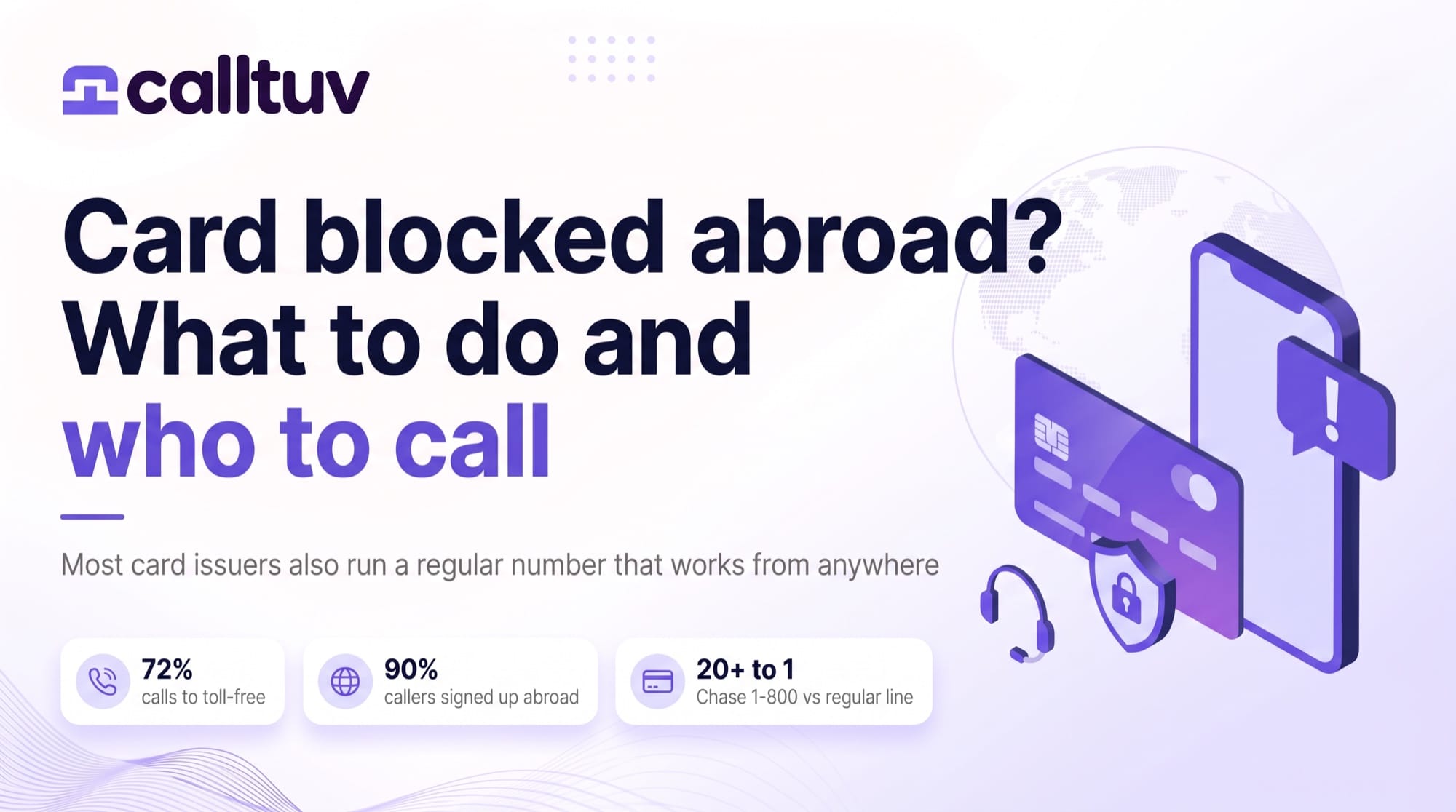
Most people don't know the regular number exists. Over the last six months, 90% of the people who called a US or Canadian card or fraud line through CallTuv had signed up outside the US, in 75 countries, and 72% of their calls went to toll-free numbers, the very numbers a foreign SIM usually can't reach. For every call to Chase's regular Card Services line in Delaware, more than 20 went to the 1-800 number printed on Chase cards.
That's not their mistake. It's the number the card tells them to call. Of course they dial it. Anyone would.
What to do, in this order
1. Check the app before you call anyone. Often it isn't a stolen card at all. It's a fraud filter reacting to a new country, a new currency or an odd hour. If your bank's app shows the alert, confirming the purchase there can clear it without a phone call.
2. Don't call a number from a text or an email. Fake fraud alerts are an old scam, and they work because they arrive at exactly the moment you're already worried about your card, standing at a counter with a queue behind you and no idea whether the block is real. A real alert can come by text. Fine. The number you call back should still come from the back of the card, the app, or the bank's own website. Never from the message.
3. If you do have to call, pick the right kind of number. The number on the back of a US card is almost always toll-free. From a foreign SIM it often fails outright, or the carrier bills it as an ordinary international call. A regular US number, one with a normal area code like 302 or 605, connects from anywhere. The tables just below have those.
4. If the card is lost or stolen, freeze it and ask about an emergency replacement. Freeze first. It's one tap in the app, and it's reversible. Then call. Ask whether the issuer can send a replacement card to where you are, and how long that takes.
If it's your phone that's gone, not just the card, our guide on what to do when your phone is stolen abroad covers the order to do things in, carrier lines included.
Who to call: card and fraud lines that answer callers abroad
Every number here is one our customers reached, with the greeting heard on the line recorded. They're regular US or Canadian numbers, so a foreign SIM can dial them, and the right-hand column says who picked up. Last checked 28 September 2026.
| Issuer | Regular number (works from abroad) | Who answered |
|---|---|---|
| Chase | +1 302 594 8200 | Chase Card Services |
| Chase | +1 614 248 2161 | Chase Card Services |
| Citi | +1 605 335 2222 | Citi Cards |
| Bank of America | +1 315 724 4022 | Bank of America international line |
| Bank of America | +1 609 459 5004 | Credit Card Fraud Department |
| Bank of America | +1 609 459 5003 | ATM Debit Card Client Protection |
| American Express | +1 336 393 1111 | American Express, "We accept collect calls" |
| Capital One | +1 804 934 2001 | Capital One |
| Wells Fargo | +1 775 335 1115 | Wells Fargo |
| US Bank | +1 503 401 9991 | US Bank |
| Visa | +1 303 967 1098 | Visa Card Services |
| Mastercard | +1 636 722 7111 | Mastercard Assistance Center |
| Mastercard (Spanish) | +1 636 722 8882 | Centro de asistencia de Mastercard |
| TD (Canada) | +1 416 307 7722 | TD Credit Cards, "We accept all collect calls" |
| RBC (Canada) | +1 416 974 7780 | RBC Royal Bank Card Services |
And these are the toll-free fraud and card lines people reach for first. They're genuine and they answer, just not reliably from a foreign SIM.
| Issuer | Toll-free number | Who answered |
|---|---|---|
| Chase | +1 800 432 3117 | Chase credit cards |
| Chase | +1 800 955 9060 | Chase Fraud Operations |
| Citi | +1 800 950 5114 | Citi Cards |
| Citi | +1 877 443 8871 | Citibank Fraud Prevention |
| Bank of America | +1 888 436 8828 | Bank of America Client Protection |
| American Express | +1 800 528 4800 | American Express |
| Capital One | +1 877 383 4802 | Capital One |
| Wells Fargo | +1 800 869 3557 | Wells Fargo |
| US Bank | +1 800 872 2657 | US Bank |
| Discover | +1 800 347 2683 | Discover |
| Visa | +1 800 847 2911 | Visa Global Customer Care |
Discover is the one issuer on the list where our customers only ever reached a toll-free number. That doesn't prove Discover has no regular line. Only that we haven't seen one connect.
A word on collect calls
When a bank tells you to "call collect" from abroad, it means a reverse-charge call placed by an operator in the country you're in. Bank of America's page for customers outside the US says you must use your country's operator, and that dialling without one may cost you international charges; Capital One's contact page reads "Credit card outside the US, call collect". We read both on 23 September 2026 for our toll-free study.
It's free if you can find an operator who'll place it. Big if. From a hotel room that's sometimes possible, but from a mobile on a foreign network, standing outside a shop with a declined card in your hand, finding an international operator who'll set up a reverse-charge call to Delaware is a small project of its own. In that case dial the same regular number directly and treat it as a normal call to the US.
Why the number on the back doesn't work abroad
A toll-free call is free because the company pays for it, and that deal mostly stops at the border, since the carriers in Portugal or Thailand or Brazil aren't part of it. So many don't carry the call. Some route it and bill you international rates. Others play a recording. Number not in service. It's a bigger problem for the US than for anywhere else. In a separate study we found 76% of US customer service lines in our directory are toll-free, against 8% in the UK.
Card issuers know this. That's why most of them also run ordinary numbers, and why some of those lines open with a sentence you'd never hear on a domestic line: "We accept collect calls."
What people calling from abroad actually dial
Here's how calls through CallTuv split between an issuer's toll-free numbers and its regular ones over the last six months. Only issuers with enough calls to mean something are shown, and only the share is published, never the count.
| Issuer | Share of calls to its toll-free numbers |
|---|---|
| Capital One | 90% |
| Wells Fargo | 86% |
| Chase | 80% |
| Citi | 78% |
| Bank of America | 77% |
| US Bank | 73% |
| American Express | 66% |
Every one of those issuers had a regular number that our customers reached. Mostly unused. American Express has the lowest toll-free share, which fits: its regular line, +1 336 393 1111, says "We accept collect calls" as soon as it picks up, and Amex prints that number for card members abroad.
Then there are Visa and Mastercard. Their own assistance centres answer on ordinary numbers, 303 in Colorado and 636 in Missouri, and Mastercard runs a separate Spanish-language line on the same exchange. They're worth a try when you can't get through to the bank itself.
Calling your bank's 1-800 number from abroad
Simplest fix: take the SIM out of the problem. CallTuv places the call over the internet from a browser, or from the iPhone or Android app, so it doesn't matter which country's network your phone is on. A US toll-free number costs $0.03 a minute, the same as any other US number. So does Canada. A 20-minute hold with a fraud team? 60 cents.
Card lines are built around phone menus, the kind that want you to press 1 for lost or stolen and then key in the card number before a person picks up. Key presses from the CallTuv keypad are sent as signals the menu reads directly, not as tones mixed into the audio. The keypad works once the call connects.
Two limits. CallTuv makes outgoing calls only, so it can't receive a verification code your bank texts or calls you with. Your own phone still gets those. And it can't call emergency numbers, so if a card theft comes with anything worse, call the local emergency number from your own phone.
Method and caveats
The numbers come from CallTuv's directory of organisation lines our customers have reached, with the organisation that answered confirmed on the call. The call figures cover connected calls placed through CallTuv between 1 April and 28 September 2026 to the US and Canadian card and fraud lines in that directory, with suspended accounts left out. "Signed up outside the US" is the country an account registered from, which isn't always where the caller was standing that day, and the toll-free share counts calls rather than people, so one anxious caller ringing the same fraud line six times weighs six times as much as someone who got through at once. Keep that in mind. Per-issuer shares cover every line we have for that issuer, not only its card lines, and are shown only where there were enough calls and callers to be stable.
What the data doesn't show is whether a given toll-free number would have failed on the caller's own SIM, since calls through CallTuv connect either way, and why people picked one number over another, though the likeliest reason is sitting in their wallet: the toll-free number is the one printed on the card.
Reuse of these figures is welcome with attribution and a link to this page.
Frequently asked questions
Can I call my bank's 1-800 number from abroad?
Often not from a foreign SIM. Many foreign carriers don't route US toll-free calls, and some bill them as international calls. Use your bank's regular number for callers abroad, or call the 1-800 number over the internet, which CallTuv does at $0.03 a minute.
What should I do if my card is blocked while travelling?
Open your bank's app first. Many blocks abroad are fraud filters, and confirming the purchase in the app can lift them. If you need to call, use a number from the card, the app or the bank's website, never one from a text.
What is Chase's number for calling from outside the US?
Our customers have reached Chase Card Services on +1 302 594 8200 and +1 614 248 2161, both regular US numbers that work from abroad. The number printed on Chase credit cards is +1 800 432 3117, which is toll-free.
How do I contact Visa or Mastercard from abroad?
Visa Card Services answered on +1 303 967 1098 and the Mastercard Assistance Center on +1 636 722 7111. Both are regular US numbers. They're worth trying when you can't get through to your bank.
Is a text saying my card was used abroad real?
It can be. Fake fraud alerts copy real ones closely. Don't reply with details and don't call a number in the message. Check the app, or call the number on the back of the card or on the bank's own website.
What does "call collect" mean?
A reverse-charge call placed by an operator in the country you're in, so the bank pays. If you can't reach an operator, dial the same regular number directly as an ordinary call.
How much does it cost to call a US bank from abroad with CallTuv?
$0.03 a minute to any US number, toll-free included, and the same to Canada. There's no subscription, top-ups start at $5, and credit doesn't expire.
Can CallTuv receive my bank's verification code?
No. CallTuv makes outgoing calls only and can't receive calls or texts. Verification codes still go to your own phone.