
What a Phone Call Costs Around the World: 232 Destinations, Priced
We priced international calls to all 232 destinations, landline and mobile. The spread is 327x, the median destination costs $0.67 a minute, and distance turns out to have almost nothing to do with it.

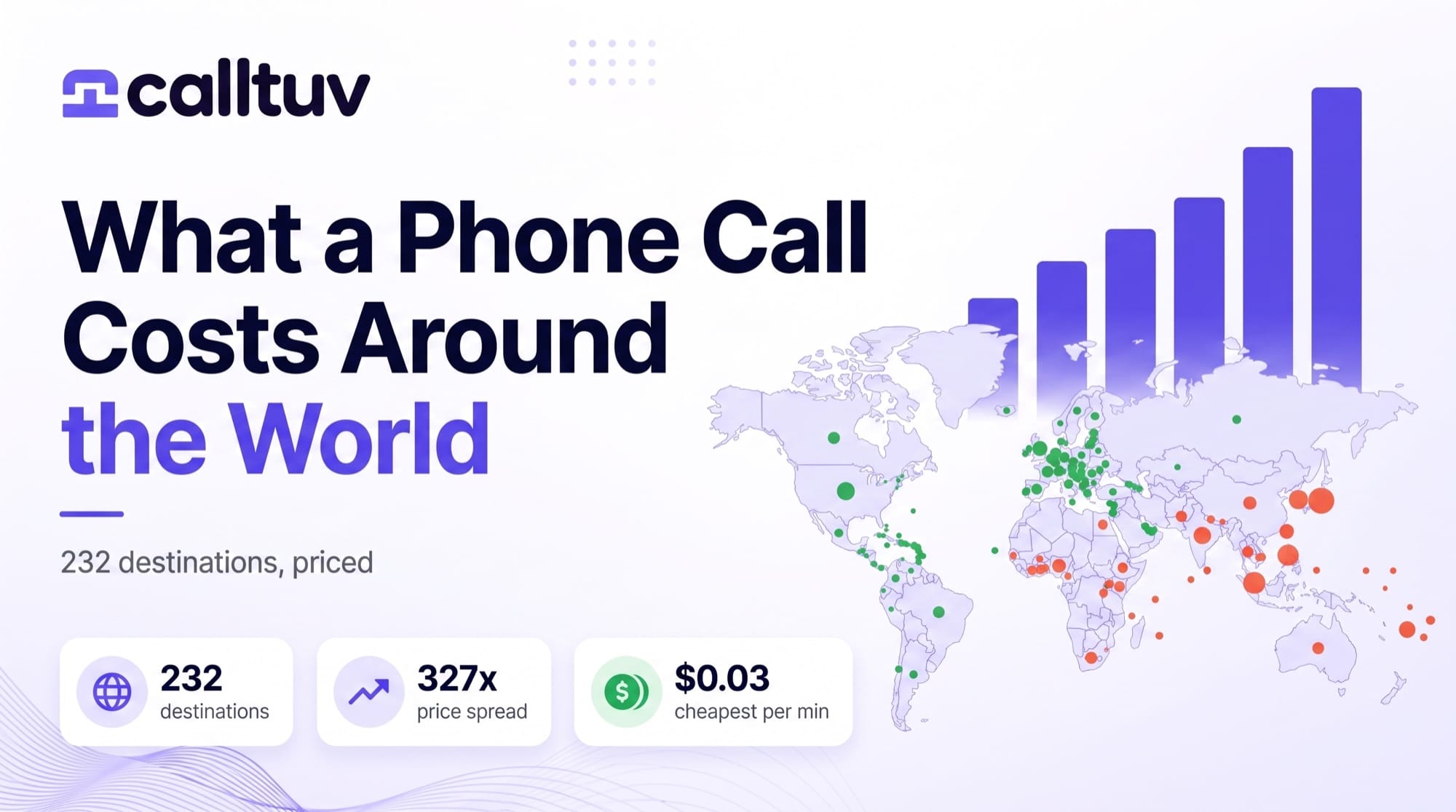
Calling a landline in Romania costs three cents a minute. Calling a landline on Norfolk Island, a speck in the Pacific with about two thousand residents, costs $9.82 a minute. Same technology, same second, same internet. A 327-fold difference.
We priced every destination CallTuv connects to, 232 of them, splitting landline and mobile, and looked for the patterns. The result is a decent map of how international calling is actually priced, and it turns out to have very little to do with distance and almost everything to do with who owns the last mile at the other end.
All figures are per minute in USD, as of 9 August 2026, taken from the published machine-readable rate card. Anyone can re-run this.
Key findings
- The spread is 327x. Cheapest destination: $0.03/min. Most expensive: $9.82/min.
- The median destination costs $0.67/min to a landline and $0.77 to a mobile. That is far more than most people would guess.
- But only 20% of destinations cost under $0.10, and those 47 destinations cover most of where calls actually go. The typical country is expensive. The typical call is cheap.
- 57% of destinations cost $0.50/min or more. The expensive tail is the majority of the map, just not the majority of the traffic.
- Mobile costs more than landline in 58% of destinations, less in 20%, and exactly the same in 22%. The "mobiles cost more" rule is real but far from universal.
- The largest mobile premium in the world is Algeria, where a mobile costs 15.3x its landline: $0.24 versus $3.68.
- Nine of the ten most expensive destinations are small island states. Distance is not the variable. Market structure is.
The 15 most expensive destinations
| # | Destination | Code | Landline | Mobile |
|---|---|---|---|---|
| 1 | Norfolk Island | +672 | $9.82 | $9.82 |
| 2 | Solomon Islands | +677 | $3.58 | $6.68 |
| 3 | Falkland Islands | +500 | $6.60 | $6.60 |
| 4 | British Indian Ocean Territory | +246 | $6.29 | $6.29 |
| 5 | Kiribati | +686 | $6.25 | $6.25 |
| 6 | Vanuatu | +678 | $6.24 | $6.24 |
| 7 | Tonga | +676 | $5.98 | $5.98 |
| 8 | Cook Islands | +682 | $5.23 | $5.23 |
| 9 | Samoa | +685 | $4.68 | $4.68 |
| 10 | Papua New Guinea | +675 | $3.60 | $4.21 |
| 11 | Algeria | +213 | $0.24 | $3.68 |
| 12 | Maldives | +960 | $3.05 | $3.54 |
| 13 | Seychelles | +248 | $3.45 | $3.45 |
| 14 | Tunisia | +216 | $3.20 | $2.55 |
| 15 | Chad | +235 | $2.94 | $1.84 |
A ten-minute call to Norfolk Island costs $98.20. The same ten minutes to Australia, its nearest large neighbour and the country that administers it, costs 60 cents.
The cheapest destinations
| Destination | Code | Landline | Mobile |
|---|---|---|---|
| United States | +1 | $0.03 | $0.03 |
| Canada | +1 | $0.03 | $0.03 |
| Romania | +40 | $0.03 | $0.07 |
| Puerto Rico | +1-787 | $0.04 | $0.04 |
| Wallis and Futuna | +681 | $0.04 | $0.04 |
| Netherlands | +31 | $0.04 | $0.05 |
| United Kingdom | +44 | $0.04 | $0.07 |
| Luxembourg | +352 | $0.04 | $0.07 |
| France | +33 | $0.04 | $0.09 |
| Italy | +39 | $0.04 | $0.09 |
| Mexico | +52 | $0.04 | $0.10 |
| Germany | +49 | $0.06 | $0.09 |
| Australia | +61 | $0.06 | $0.15 |
| Israel | +972 | $0.06 | $0.13 |
Wallis and Futuna is the anomaly that proves the argument. It is a French Pacific territory of about 11,000 people, sitting between Fiji and Samoa. Samoa costs $4.68 a minute. Wallis and Futuna costs four cents. The difference is not geography, population or remoteness, all of which are near identical. It is that one is inside the French telecoms regime and one is not.
Distance is not the variable
The intuition that a longer call costs more is a holdover from an era when it was true. Today the audio for a call to Sydney and a call to the house next door travel the same fibre for effectively the same cost. What you are paying for is the handover at the far end.
Every international call has to be delivered onto the destination's local network, and that local carrier charges a fee for accepting it: the termination rate. That fee is set by the destination's regulator and market, and it is the single biggest component of what you pay. This produces the pattern the data shows:
- Where regulators forced termination rates down, calls are cheap. The EU capped them aggressively over the past fifteen years, which is why every large Western European country lands between $0.04 and $0.09 despite high labour costs and high wages.
- Where a single carrier holds a monopoly and nobody is regulating it, calls are expensive. Small island states are the extreme case: one operator, no competitive pressure, and a diaspora that has no choice but to call home. High termination rates become a national revenue stream.
- Poverty does not predict price. India costs $0.10 to a mobile. Norfolk Island costs $9.82. The variable is market structure, not wealth.
The mobile premium, and where it inverts
Calling a mobile usually costs more than calling a landline, because mobile termination rates have historically been higher. But this is much less universal than expected:
| Relationship | Destinations | Share |
|---|---|---|
| Mobile costs more than landline | 134 | 58% |
| Mobile costs less than landline | 46 | 20% |
| Identical | 52 | 22% |
The steepest premiums:
| Destination | Landline | Mobile | Multiple |
|---|---|---|---|
| Algeria | $0.24 | $3.68 | 15.3x |
| Martinique | $0.06 | $0.71 | 11.8x |
| Andorra | $0.12 | $0.74 | 6.2x |
| Bulgaria | $0.07 | $0.43 | 6.1x |
| Argentina | $0.13 | $0.71 | 5.5x |
| Panama | $0.13 | $0.69 | 5.3x |
| Switzerland | $0.09 | $0.37 | 4.1x |
Algeria is worth pausing on. At $0.24 to a landline it is an unremarkable, affordable destination. At $3.68 to a mobile it is one of the ten most expensive numbers you can dial anywhere on earth. Same country, same call, a 15-fold difference decided entirely by which network the recipient happens to be on. In a country where mobile penetration vastly exceeds fixed lines, nearly every real call lands on the expensive side.
Where mobile is cheaper
In 46 destinations the usual rule reverses, and this is the finding most likely to save people money because it is so counterintuitive:
| Destination | Landline | Mobile | Mobile is |
|---|---|---|---|
| Curacao | $2.32 | $0.48 | 4.8x cheaper |
| Caribbean Netherlands | $2.32 | $0.48 | 4.8x cheaper |
| Peru | $0.34 | $0.15 | 2.3x cheaper |
| Sudan | $2.18 | $1.03 | 2.1x cheaper |
| Belgium | $0.15 | $0.08 | 1.9x cheaper |
| Colombia | $0.15 | $0.08 | 1.9x cheaper |
| India | $0.14 | $0.10 | 1.4x cheaper |
| South Africa | $0.95 | $0.75 | 1.3x cheaper |
| Russia | $0.87 | $0.69 | 1.3x cheaper |
The common thread is a modernised, fiercely competitive mobile market sitting alongside a neglected fixed-line incumbent. India is the clearest example: a mobile price war drove mobile termination to near nothing, while the legacy landline network stayed expensive to reach. If you are calling India and you have both numbers for someone, the mobile is the cheaper call. That is the opposite of the advice most people carry around.
What the destinations people actually call cost
Aggregate statistics are skewed by dozens of tiny territories almost nobody dials. Here are the corridors that carry real diaspora and business volume:
| Destination | Landline | Mobile | One hour (cheaper side) |
|---|---|---|---|
| United States | $0.03 | $0.03 | $1.80 |
| Canada | $0.03 | $0.03 | $1.80 |
| Romania | $0.03 | $0.07 | $1.80 |
| United Kingdom | $0.04 | $0.07 | $2.40 |
| Mexico | $0.04 | $0.10 | $2.40 |
| Spain | $0.04 | $0.10 | $2.40 |
| Germany | $0.06 | $0.09 | $3.60 |
| Brazil | $0.07 | $0.14 | $4.20 |
| Poland | $0.07 | $0.15 | $4.20 |
| India | $0.14 | $0.10 | $6.00 |
| South Korea | $0.12 | $0.11 | $6.60 |
| Bangladesh | $0.12 | $0.12 | $7.20 |
| Turkey | $0.15 | $0.58 | $9.00 |
| Thailand | $0.20 | $0.20 | $12.00 |
| Indonesia | $0.22 | $0.22 | $13.20 |
| Pakistan | $0.31 | $0.36 | $18.60 |
| Vietnam | $0.39 | $0.36 | $21.60 |
| Egypt | $0.42 | $0.42 | $25.20 |
| Philippines | $0.42 | $0.59 | $25.20 |
| Nigeria | $0.47 | $0.47 | $28.20 |
| Ukraine | $0.63 | $0.82 | $37.80 |
| Kenya | $0.76 | $0.79 | $45.60 |
| Morocco | $1.07 | $2.15 | $64.20 |
The gap inside this table is the real story of international calling economics. An hour to a US number costs $1.80. An hour to Morocco costs $64.20, and to a Moroccan mobile $129. Both are ordinary calls between ordinary people, and one costs 36 times the other.
Notice too where the burden falls. The cheapest corridors, the US, Canada, Western Europe, are also the wealthiest. The expensive ones, sub-Saharan Africa, North Africa, the Pacific, are largely poorer countries with large populations working abroad and sending money and calls home. International calling is one of the few markets where price is inversely correlated with the customer's ability to pay.
Method and data notes
So this can be checked and reused:
- Source: the published CallTuv rate card at calltuv.com/pricing.md, a machine-readable document generated from the same pricing lookup that powers the public rate pages.
- Date: rates as of 9 August 2026. Rates change; re-fetch the source for current figures.
- Coverage: 232 destinations, each with a separate landline and mobile rate. Territories with their own dialing codes and their own rates are counted separately, which is why Jersey, Guernsey and the Isle of Man appear apart from the UK.
- Currency: USD, per minute of connected time, exclusive of tax.
- "Median destination" means the median across destinations, not across calls. It is deliberately not weighted by call volume, because the unweighted figure is what shows the shape of the map.
- Two notable absences: China and Cuba are not in the catalogue. Calls to China are not currently supported for regulatory and carrier reasons, so China is excluded from every figure here rather than counted as zero.
- These are CallTuv's retail rates. Absolute numbers differ between providers, and each negotiates its own wholesale deals. What does not differ is the structure: a call to Norfolk Island terminates on a monopoly island network and a call to Romania terminates into a regulated EU market, and that is what produces the spread described here.
If you want to check a single destination rather than the whole set, every rate is on the public rates pages, and the call cost calculator will price a call of a given length without an account.
What to do with this
Four practical conclusions fall out of the data:
- Check landline versus mobile before a long call. In 20% of destinations the mobile is cheaper, sometimes several times cheaper. India, Colombia, Peru, Belgium, South Africa and Russia are all in that group.
- Never assume from the region. Romania is as cheap as the US. Neighbouring Pacific islands differ by 100x. There is no rule of thumb that survives contact with the data.
- For expensive destinations, the number type matters more than anything else. Algeria at $0.24 versus $3.68 is the difference between a normal call and an eye-watering one.
- Check the rate before dialing, not after. With a 327x spread and no relationship to distance, intuition is not a usable guide.
That last point is why the rate is shown before the call starts on CallTuv rather than being discoverable only on a bill. On a map this uneven, seeing the number first is the whole game.
FAQ
What is the most expensive country to call?
Norfolk Island, at $9.82 per minute to both landlines and mobiles. It is an Australian external territory in the Pacific with roughly 2,000 residents.
What is the cheapest country to call?
The United States, Canada and Romania, all at $0.03 per minute to landlines. Romania is the surprise: an EU country as cheap to reach as a domestic US call.
Why does calling some countries cost so much more?
Because of termination rates, the fee the destination's local carrier charges to deliver the call onto its network. That fee is set by the destination's market and regulator. Where a single carrier has a monopoly and no regulatory pressure, it stays high. Distance plays essentially no part.
Is it cheaper to call a landline or a mobile?
Usually a landline, but only in 58% of destinations. In 20% the mobile is cheaper, and in 22% they cost the same. Check the specific destination instead of assuming.
Why is calling India cheaper on a mobile than a landline?
India's mobile market went through an intense price war that drove mobile termination rates to near nothing, while the legacy fixed-line network stayed comparatively expensive to reach. $0.10 to a mobile against $0.14 to a landline.
What does a one-hour international call cost?
It depends enormously on the destination: $1.80 to the US, $2.40 to the UK, $6.00 to India, $25.20 to the Philippines, $64.20 to a Moroccan landline.
Do these prices change?
Yes. Termination rates get renegotiated and regulators intervene, so rates move. These figures are dated 9 August 2026 and the source document is regenerated from live pricing.
Can I reuse this data?
Yes, with attribution and a link. The underlying rate card is public at calltuv.com/pricing.md if you would rather run your own analysis.
The bottom line
There is no such thing as the price of an international call. There are 232 prices, they span a factor of 327, and where any given country lands is decided by regulation and market structure at the far end rather than by anything about the call itself.
The practical version is short. The countries most people call are cheap, often only a few cents a minute. The countries that are expensive are expensive for reasons that have nothing to do with you and will not change on your timescale. And because none of it is predictable from geography, the only reliable move is to look up the number before you dial it.