
Call Fraud in 2026: Robocall Volume Is Flat, Losses Hit a Record
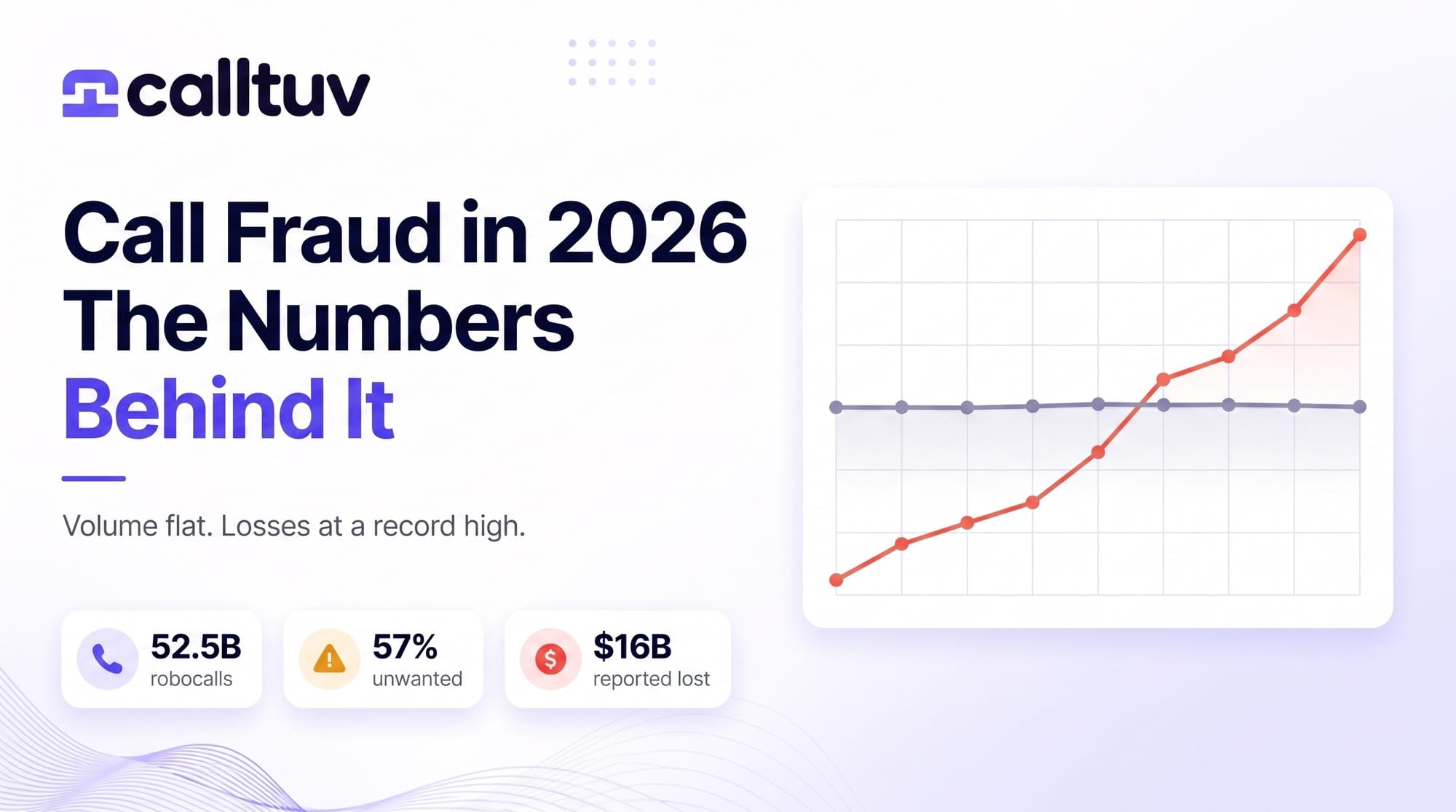
Americans got 52.5 billion robocalls in 2025, slightly fewer than 2024. Reported fraud losses hit a record 16 billion dollars. The robocall problem is not growing, it is concentrating: unwanted and scam calls rose to 57% of all traffic while legitimate automated calls fell.

Ask almost anyone and they'll tell you robocalls keep getting worse every year. More of them, every year, forever.
That's not what the data says. Americans got 52.5 billion robocalls in 2025, which is slightly fewer than the 52.8 billion they got in 2024. Volume has been stuck between roughly 50 and 55 billion for five years running. It hasn't gone up.
Reported fraud losses over the same stretch hit $16 billion. Highest on record, up about 25% in twelve months.
Flat calls. Record losses. The robocall problem isn't growing, it's concentrating, and that turns out to be the more troubling version of the story.
Here's what the primary sources actually say for 2025 and 2026, with every number dated and attributed. US data throughout.
The numbers at a glance
| Metric | Figure | Period | Source |
|---|---|---|---|
| Total robocalls | 52.5 billion | 2025 | YouMail Robocall Index |
| Robocalls, prior year | 52.8 billion | 2024 | YouMail Robocall Index |
| Unwanted telemarketing and scam calls | 29.6 billion, up 15.4% | 2025 | YouMail Robocall Index |
| Malicious share of all robocalls | 57%, up from 49% | 2025 vs 2024 | YouMail Robocall Index |
| Robocalls per day, December | 140.6 million (1,627 per second) | Dec 2025 | YouMail Robocall Index |
| Total reported fraud losses | About $16 billion, up about 25% | 2025 | FTC |
| Reported losses to imposter scams | $3.5 billion | 2025 | FTC |
| Share of fraud reports that are imposter scams | Nearly 1 in 3 | 2025 | FTC |
| Losses to government impersonators | About $920 million, up from $789 million | 2025 vs 2024 | FTC |
| Losses to business impersonators | Nearly $1 billion, up from $866 million | 2025 vs 2024 | FTC |
| Numbers on the Do Not Call Registry | More than 258 million, up 4.8 million | End of FY2025 | FTC |
| Do Not Call complaints | More than 2.6 million | FY2025 | FTC |
| FTC robocall lawsuits since 2003 | 173 suits, 570 companies, 449 individuals | 2003 to FY2025 | FTC |
| Collected from those violators | Nearly $400 million | 2003 to FY2025 | FTC |
| STIR/SHAKEN implementation, large carriers | Over 95% | Early 2026 | FCC framework reporting |
Call volume peaked a while ago
YouMail's Robocall Index, published on 8 January 2026, put last year at 52.5 billion calls. That's down less than 1% from 52.8 billion in 2024. Go back further and the picture is the same: annual volume has sat in a band of roughly 50 to 55 billion for five consecutive years. October 2025 was actually a multi-year low, though volume rose again in November and December.
December on its own accounted for just under 4.1 billion calls. Averaged out, that's 140.6 million a day, or 1,627 every second.
Enormous numbers. But not growing ones.
So if you're convinced robocalls got worse last year, the volume data won't back you up, and that gap between what the aggregate says and what people actually experience is the most interesting thing in the whole dataset, because it turns out both are true at once and the reconciliation shows up the moment you stop looking at the total and start looking at what the calls were.
What changed was the mix
This is the part that usually gets buried under the headline number, and it's the whole story.
| Type | 2025 volume | Change | Share of all robocalls |
|---|---|---|---|
| Notifications | 13.3 billion | Down 13.5% | 25%, down 4 points |
| Payment reminders | 9.4 billion | Down 19.6% | 18%, down 4 points |
| Telemarketing and scams | 29.6 billion | Up 15.4% | 57%, up 8 points |
Legitimate automated calling fell off a cliff. Appointment reminders, delivery alerts, the payment nudge from your dentist, all the calls people mostly don't mind, dropped 13.5% and 19.6% respectively. The unwanted telemarketing and scam category went the other way and climbed 15.4%.
Put those together and the malicious share of robocall traffic went from 49% to 57% inside a single year. A coin flip became a clear majority. In plain terms: the next recorded call your phone receives is now more likely than not to be one nobody asked for, which simply wasn't the case twelve months earlier.
Which also explains the perception gap. Total volume is flat, so if last year felt worse to you, you weren't imagining it. The calls got worse without getting more numerous.
Then there's the money
The FTC reported roughly $16 billion in fraud losses for 2025. It's the highest figure they've ever recorded, about 25% above 2024, when the total came to $12.5 billion.
Imposter scams did the most damage. People reported $3.5 billion lost to them last year, with losses up nearly threefold since 2020. They were also the single most-reported category, turning up in close to one of every three fraud reports the agency received.
Breaking that down:
- Business impersonators: nearly $1 billion, up from $866 million in 2024. Fake banks did the most damage inside that group.
- Government impersonators: about $920 million, up from $789 million.
The FTC is specific about the pattern behind the costliest cases, and it's worth knowing because it barely varies. A fake security alert arrives, usually appearing to come from your bank. Then comes the pressure to move your money somewhere safe. What makes this particular script so expensive, and the reason it dominates the loss figures rather than the complaint figures, is that it doesn't ask the victim for a fixed sum the way a fake invoice or a prize scam does, so losses tend to stop only when the person runs out of money to move.
Two caveats, and they matter. These are reported losses, and most fraud never gets reported at all, so the real number is bigger than $16 billion. Second, that total covers every contact method the FTC tracks, including social media, email and text. It is not a phone-only figure. If you see someone quoting "$16 billion lost to phone scams," they've misread the source.
What the calls are actually about
Every two years the FTC reports to Congress on the Do Not Call Registry. The January 2026 edition ranks the most-reported unwanted telemarketing calls of FY2025 like this:
- Debt reduction schemes
- Imposters, meaning callers posing as government, business, or family and friends
- Medical and prescription inquiries
- Energy, solar and utilities
- Home improvement and cleaning
That same report counts more than 258 million numbers sitting on the Do Not Call Registry at the close of FY2025, up by over 4.8 million in a year, and more than 2.6 million Do Not Call complaints filed during FY2025.
There's a detail in that complaint figure worth pausing on. Complaints about illegal telemarketing robocalls dropped steadily every year from FY2017 through FY2024. Then FY2025 broke the streak and ticked back up, though they remain well below the FY2017 peak.
Notice the timing. That inflection lines up with the mix shift in the volume data, which means two datasets gathered by different organisations, measuring different things, using entirely different methods, turned in the same year. Neither one proves anything on its own. Together they're harder to dismiss.
Enter the cloned voice
The regulatory turning point has a date: 8 February 2024. That's when the FCC adopted a Declaratory Ruling holding that calls using AI-generated voices count as "artificial" under the Telephone Consumer Protection Act. Practically speaking, voice cloning in robocalls became illegal without prior express consent, under a law that was already on the books. No new legislation required.
The case that triggered it is still the clearest example anyone has. Two days out from the January 2024 New Hampshire primary, roughly 5,000 voters picked up the phone to an AI clone of President Biden's voice telling them to stay home. What followed:
- A $6 million forfeiture order against political consultant Steve Kramer, first proposed in May 2024 and adopted 26 September 2024 under the Truth in Caller ID Act. Kramer admitted writing the script, commissioning the cloned voice, and spoofing the number of a New Hampshire political operative who had nothing to do with any of it.
- A $1 million settlement with Lingo Telecom, the carrier that actually moved the calls, announced 21 August 2024 along with a compliance plan covering caller ID authentication. The FCC had originally asked for $2 million.
Of the two, Lingo is the one that mattered. It established that whoever carries the traffic answers for it, not just whoever dreamed it up. Follow the regulatory thread from there and you'll find that principle running through nearly everything since.
What the regulators have actually done
The FTC. Since the Do Not Call Registry opened in 2003, the agency has filed 173 lawsuits against 570 companies and 449 individuals and collected close to $400 million. Its strategy has shifted noticeably toward infrastructure: going after the VoIP providers that carry illegal calls, and suing the dialing platforms and soundboard vendors that supply the tooling, instead of only chasing whoever placed the call.
Its Impersonation Rule, finalised in 2024, lets it pursue civil penalties and consumer redress directly. A dozen actions under that rule have produced over $70 million in redress so far. The 2025 cases were against American Tax Service, MediaAlpha, Click Profit, Blackstone Legal and Accelerated Debt Settlement, followed by a complaint against Innovative Partners in April 2026.
The FCC. Past the AI ruling and the deepfake penalties, most of its attention sits on caller ID authentication. Large US carriers had pushed STIR/SHAKEN implementation past 95% by early 2026. A Further Notice of Proposed Rulemaking, scheduled for the commission's 20 May 2026 open meeting, proposes "Know Your Upstream Provider" duties and tighter rules on how providers hand out authentication attestations.
The states. August 2025 saw 51 state attorneys general, from both parties, launch Operation Robocall Roundup and send warning letters to 37 voice providers over illegal traffic crossing their networks.
So why do the calls still land?
Set the enforcement record beside the outcomes and the mismatch is hard to miss. Nearly $400 million recovered across twenty-two years, against $16 billion lost in 2025 alone. Caller ID authentication above 95%, alongside a rising share of malicious traffic.
Three structural reasons explain it, and they're worth understanding because they tell you what comes next.
Authentication proves origin, not honesty. STIR/SHAKEN attests that a call genuinely came from the number on your screen. It says nothing about whether the person behind it is telling the truth. A scammer calling from a number they legitimately control can earn full attestation without breaking a sweat. That gap is exactly why the FCC's May 2026 proposal goes after how attestations get assigned instead of pushing deployment higher. Deployment was never the thing holding this back.
Enforcement moves slower than incorporation. Cases take years to build. A provider can be registered, carry traffic, and dissolve well inside that window. Chasing carriers instead of callers, which is the FTC's stated shift, is a direct response: infrastructure is harder to spin up again than a shell company.
Origination went offshore. Domestic rules bind domestic providers, full stop. Traffic arriving from abroad through gateway providers is why "Know Your Upstream Provider" is the live question in 2026, and why 51 attorneys general wrote to carriers instead of callers.
One theme runs through all three. Pressure on the compliant middle of the market works, and you can see it in the data: legitimate notification traffic fell 13.5% while scam traffic grew 15.4%. Regulation successfully squeezed the operators who answer letters. The ones who don't answer letters grew.
What this means if you make or receive calls
For anyone on the receiving end, a 57% malicious share means treating an unexpected recorded call as presumptively unwanted is now simply the correct default, statistically speaking. And the FTC's guidance on the highest-loss pattern is about as blunt as government advice gets: no agency and no bank will ever call you and ask you to move money to protect it.
There's a second-order effect that gets far less attention, though.
Aggressive filtering is standard across carriers now, and filters fail in one particular direction. They punish calls that look unusual. A perfectly legitimate call placed from abroad often shows up tagged "Spam Likely," or with no verification at all, and gets declined before it rings twice. We covered this separately in a piece on why international calls fail to connect, where spam filtering is a fast-growing entry on the list. If you want the cost side of international calling instead, we priced all 232 destinations separately.
Call it the quiet cost of the past five years. The enforcement regime made unsolicited calling harder, which was the entire point and largely worked, but the same machinery that learned to distrust an unfamiliar number placed at scale from an unfamiliar network has no reliable way to tell that particular pattern apart from a daughter in London ringing a hospital ward in Lagos, and so it doesn't.
Somebody absorbs that cost. It isn't the scammers.
Method and sources
So you can check this or reuse it:
- Robocall volumes come from the YouMail Robocall Index release dated 8 January 2026. YouMail estimates national volume by extrapolating from traffic hitting its own user base. It's the most widely cited series going, but treat it as a modelled estimate, not a census of the network.
- Loss figures come from FTC releases published in 2026 covering 2025, and they are reported losses drawn from consumer complaints. Real losses run higher, since most fraud goes unreported. These totals also span every contact method, not phone alone.
- Do Not Call figures come from the FTC's biennial report to Congress issued in January 2026, covering fiscal year 2025. Fiscal years and calendar years aren't interchangeable, so we've labelled which is which throughout.
- Regulatory items are dated to adoption or announcement. That May 2026 FCC item is a proposal, not an adopted rule.
- Scope is the United States. Robocall dynamics look quite different under other regulatory regimes.
- Reuse is welcome with attribution and a link. Where a number is available straight from the FTC or FCC, cite them instead of us. The FTC keeps a running robocall topic page that is a better starting point than any secondary roundup, including this one.
FAQ
How many robocalls did Americans get in 2025?
52.5 billion, per the YouMail Robocall Index, down less than 1% from 52.8 billion in 2024. Annual volume has held between roughly 50 and 55 billion for five years.
Are robocalls getting worse?
Not in volume, but yes in composition. Unwanted telemarketing and scam calls rose 15.4% in 2025 and reached 57% of all robocall traffic, up from 49% a year earlier, while legitimate notification calls fell.
How much did Americans lose to fraud in 2025?
About $16 billion in reported losses, the highest on record and roughly 25% above 2024's $12.5 billion. That covers all contact methods, not just phone calls, and counts only what people reported.
What is the most common phone scam?
Imposter scams. They were reported more than any other fraud category in 2025, appeared in nearly one of three fraud reports, and accounted for $3.5 billion in reported losses. Bank impersonation caused the heaviest losses within the business impersonator group.
Are AI voice robocalls illegal?
Yes. On 8 February 2024 the FCC ruled that AI-generated voices are "artificial" under the TCPA, making such calls illegal without prior express consent. The consultant behind the New Hampshire Biden deepfake calls drew a $6 million forfeiture order, and the carrier that transmitted them settled for $1 million.
Does STIR/SHAKEN stop scam calls?
Not on its own. It verifies that a call really came from the number displayed. It does not verify that the caller is honest. Large US carriers passed 95% implementation by early 2026, which is why current FCC proposals target how attestations are assigned instead of how widely the system is deployed.
How many numbers are on the Do Not Call Registry?
More than 258 million as of the end of fiscal year 2025, up by more than 4.8 million over the prior fiscal year.
Why do my legitimate calls get flagged as spam?
Carrier filtering is tuned aggressively and penalises unfamiliar calling patterns, so genuine calls, international ones especially, can arrive labelled "Spam Likely" and go unanswered. Our help centre covers what to do when your number shows as spam. It lands hardest on the people ringing banks and government offices from another country, which is where most cross-border calling actually goes. It's a side effect of the same enforcement push that reduced unwanted calling.
The bottom line
Robocall volume peaked years ago and has been flat ever since. That's a real enforcement achievement and it deserves saying out loud, because almost nobody does.
It's also not the number that counts. Whatever traffic is left is far likelier to be malicious than it was a year ago, 57% against 49%, and the money pulled out of it hit a record $16 billion. Pressure on the industry worked on the operators you can reach with a letter or a lawsuit. The share nobody could reach grew, moved offshore, and picked up voice cloning on the way.
Which is why the 2026 agenda is about upstream providers and attestation integrity instead of deployment targets. The problem worth measuring stopped being how many calls get made. It became who's placing them, and whether anyone in the chain that carried the call can be made to answer for it.