Published in Our data
The Best Time to Call: 8 to 10 a.m. Gets 1.6x the Conversations of the Afternoon
Our call data on US numbers: calls at 8 to 10 a.m. their time became a real conversation 29.7% of the time, against 18.9% from 1 to 4 p.m. The day of the week barely mattered.

By Yosi Dahan6 min read

On this page · 7 sections
The best time to call someone in the US is 8 to 10 a.m. their time. In calls placed through CallTuv to US phone numbers between April and November 2026, 29.7% of calls made between 8 and 10 a.m. local time turned into a real conversation of a minute or more. Between 1 and 4 p.m. it was 18.9%. Same people, same kinds of numbers, and the morning got roughly 1.6 times as many real conversations.
The worst single hour was 2 p.m., at 15.4%. That's awkward for the usual advice, which often lists 2 to 4 p.m. as a good window.
Two more things surprised us. The share of calls that got answered barely moved from one hour to the next, which means the whole difference between a good hour and a bad one happens after the other person picks up, in whether they stay on the line long enough to actually talk. And the day of the week hardly mattered at all.
What the data shows, hour by hour
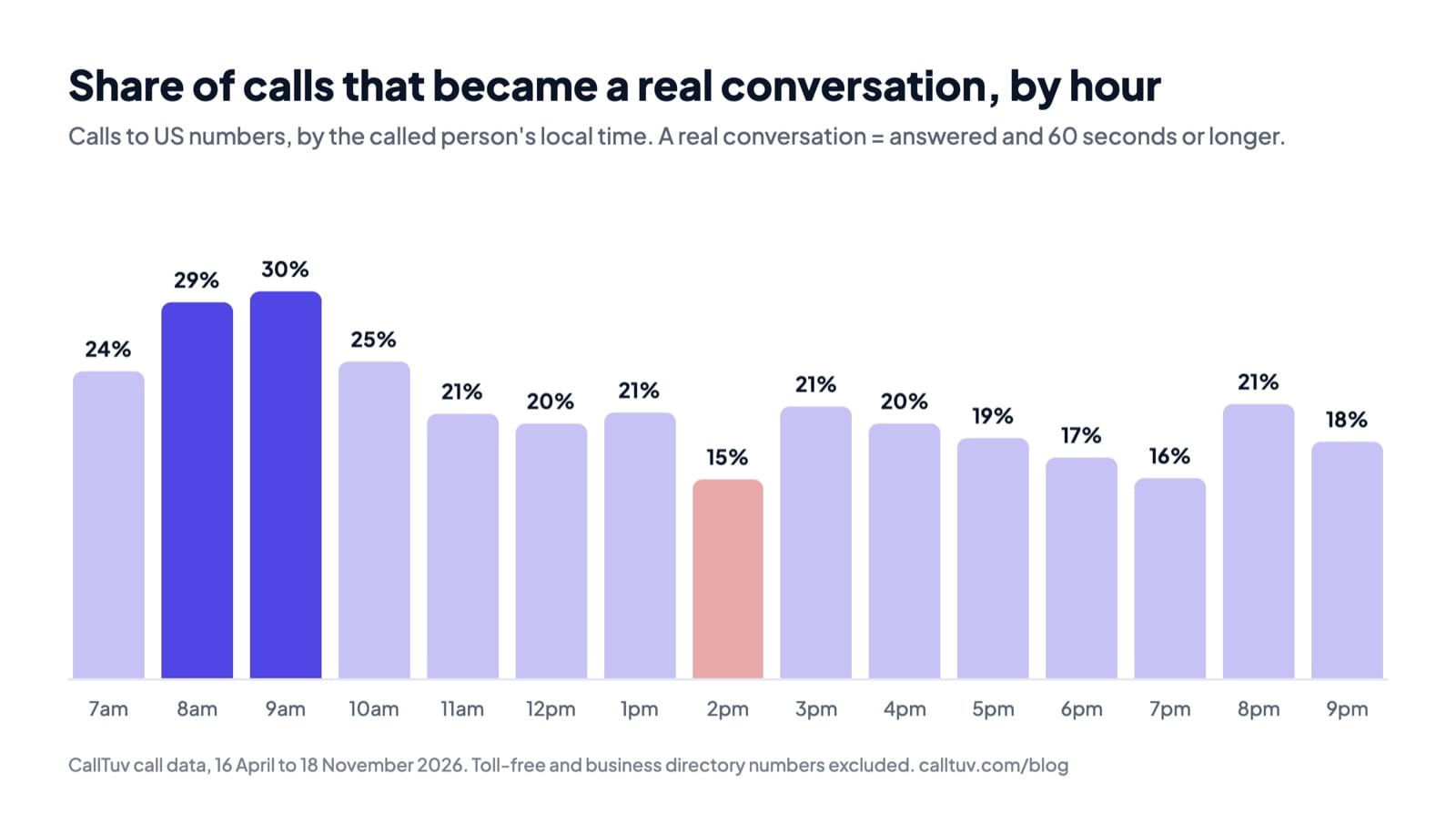
We grouped every call by the hour it was placed in the called person's own time zone, worked out from their area code, so that a call from Lisbon at 3 p.m. to a number in Denver counts as an 8 a.m. call, because 8 a.m. is what the clock said where the phone rang, and then counted how often each hour's calls became a conversation of at least 60 seconds.
| Called person's local time | Became a 60s+ conversation |
|---|---|
| Before 8 a.m. | 22.8% |
| 8 a.m. to noon | 25.3% |
| Noon to 5 p.m. | 19.2% |
| 5 p.m. to 8 p.m. | 17.3% |
| After 8 p.m. | 20.5% |
Look closer at the morning and it's really two hours doing the work: 8 a.m. at 29.2% and 9 a.m. at 30.0%. By 11 a.m. the rate is back to 20.5%, about where it sits for most of the afternoon. The early evening, when plenty of people assume others are home and free, was the weakest stretch of the working day.
The gap between the morning and the afternoon isn't noise. It's about ten standard errors wide, which is the statistical way of saying you'd almost never see a gap that size by chance.
Answered isn't the same as talking
Here's the part we didn't expect. Across the whole day, about 71% of calls were answered, and that number stayed in a narrow band from hour to hour. At 2 p.m., the worst hour for conversations, 66.7% of calls were still being answered.
So the call connects either way. What changes is what happens next. Some of those afternoon "answers" are voicemail picking up, and some are people taking the call just long enough to say they're busy. Of the calls that were answered between 8 and 10 a.m., 39.2% went past a minute. Between 1 and 4 p.m., only 27.5% did.
If you track only whether your calls connect, you'll think the time of day doesn't matter. Track whether people actually talk to you, which is the only number that turns into a booking, a sale or a solved problem, and it matters a lot.
The day of the week barely matters
Most guides will tell you Tuesday, or Wednesday and Thursday, or anything but Monday. In our data the weekdays were nearly flat:
| Day (their time) | Became a 60s+ conversation |
|---|---|
| Monday | 22.4% |
| Tuesday | 20.1% |
| Wednesday | 20.9% |
| Thursday | 22.4% |
| Friday | 22.0% |
| Saturday | 18.8% |
| Sunday | 19.9% |
Tuesday, the day with the most calls, was actually one of the weaker weekdays. Weekends ran a little lower, but the spread between the best and worst day was under four points, against more than fourteen points between the best and worst hour. Pick the hour carefully. Don't lose sleep over the day.
Why the morning works
We can only see what happened on the calls, not why, but the pattern fits ordinary life closely enough that it's hard to find it surprising once you picture a normal weekday from the other end of the line. At 8 or 9 a.m. most people are up, at their desk or on the way there, and their day hasn't filled up yet. By early afternoon they're in meetings, catching up after lunch, or deep in something, and an unexpected call is easy to cut short. In the early evening they're commuting, cooking or with family.
It also fits what a callback request is. Someone who left their number on your website yesterday evening, while they were comparing options on the sofa, is often still thinking about it the next morning over coffee, before the inbox, the meetings and the school run push it out of their head for the rest of the day.
How to use this when you call people back
- Call in their morning, not yours. The hour that counts is the one on their clock. If you're in London calling Chicago, 8 a.m. their time is 2 p.m. yours, which is a perfectly good time to make calls.
- Batch your callbacks. Leave the requests that come in during the afternoon and evening for a block at 8 to 10 a.m. the next day, their time. That's the window where a call most often turns into a conversation.
- Don't judge a call list by its answer rate. Count calls that went past a minute. That's closer to what you actually want.
- Try again at a different hour. If an afternoon call got a short "can't talk now", the next morning is a better bet than calling back an hour later.
If your leads come through the CallTuv callback widget, the Leads list already shows each visitor's local time with a colored dot, so you can see at a glance whose morning it is. Calls to US numbers cost $0.03 a minute from anywhere, and you can place them from your browser.
How we measured it
This is CallTuv's own call data, and it comes with caveats worth stating plainly.
- The calls. Outbound calls placed through CallTuv to US phone numbers from 16 April to 18 November 2026, counting the leg to the person called. We excluded toll-free numbers (800, 833, 844, 855, 866, 877, 888), numbers in our directory of verified business lines, and calls from blocked accounts, so the picture leans toward calls to people rather than to companies.
- Their local time. Worked out from the number's area code using the area code list for the North American Numbering Plan. Area codes that cover two time zones, such as northwest Florida's 850 or Idaho's 208, were left out. A mobile number can travel with its owner, so some calls will be assigned the wrong zone.
- A "real conversation" means a completed call that lasted 60 seconds or more. It's a proxy. A long voicemail counts, and a short but useful call doesn't.
- "Answered" means the call connected for at least a second, which includes voicemail.
- Not an experiment. Nobody assigned calls to hours at random. The people calling at 8 a.m. may differ from those calling at 2 p.m. in ways we can't see. Hours with too few calls to be reliable, from 10 p.m. to 6 a.m., aren't reported hour by hour.
- Who's calling. Many CallTuv users are calling the US from abroad: family, banks, landlords, clients. This isn't a study of professional cold-calling teams.
We report percentages only. If you'd like to cite these numbers, please link to this page.
Frequently asked questions
What is the best time to call someone in the US?
Between 8 and 10 a.m. in their time zone. In our data, 29.7% of calls placed then became a conversation of a minute or more, against 18.9% between 1 and 4 p.m.
What is the worst time to call?
Early afternoon and early evening. The single weakest hour in our data was 2 p.m., when 15.4% of calls became a real conversation, and 5 to 8 p.m. averaged 17.3%.
What is the best day to make calls?
It barely matters. Weekdays ranged from 20.1% to 22.4% of calls becoming a real conversation. The hour you call makes a much bigger difference than the day.
Are calls answered more often in the morning?
Only slightly. About 71% of calls were answered across the day. What changes in the morning is how often an answered call turns into an actual conversation.
Is this the best time for cold calls too?
Our data covers all kinds of calls to US numbers, not just sales calls, so treat it as a strong starting point rather than a rule. The morning gap was large, and far too wide to be chance.
How do I know what time it is where my lead is?
Check their area code or country. If they asked for a call through the CallTuv callback widget, the Leads list shows their local time and whether it's a good moment to call.
How much does it cost to call the US from abroad?
With CallTuv, calls to US landlines and mobiles cost $0.03 a minute, billed by the minute from prepaid credit, with no subscription.

Make the call from your browser
Reach landlines and mobiles in 200+ countries. Pay as you go and see the rate before you dial.
Open the web dialerOr call from your phone